
10 Sept 2026AI by Role
AI just saved you 15 hours this week. What great marketers do next
Most marketing teams now use AI and many save 10 hours or more a week. The difference is what the best marketers do with the time they get back.
Author: Team Thinqmesh · 5 min read
- HubSpot
- Canva
- Mailchimp
- Semrush
- Google Ads
- Google Analytics
- ChatGPT
86.4% of marketing teams now use AI, and about a third of marketers say it saves them more than 15 hours a week (HubSpot, 2026). That is two working days handed back. The question is no longer whether marketers use AI. It is what they do with the time, and whether the work they ship is actually better.
What the numbers say for marketing
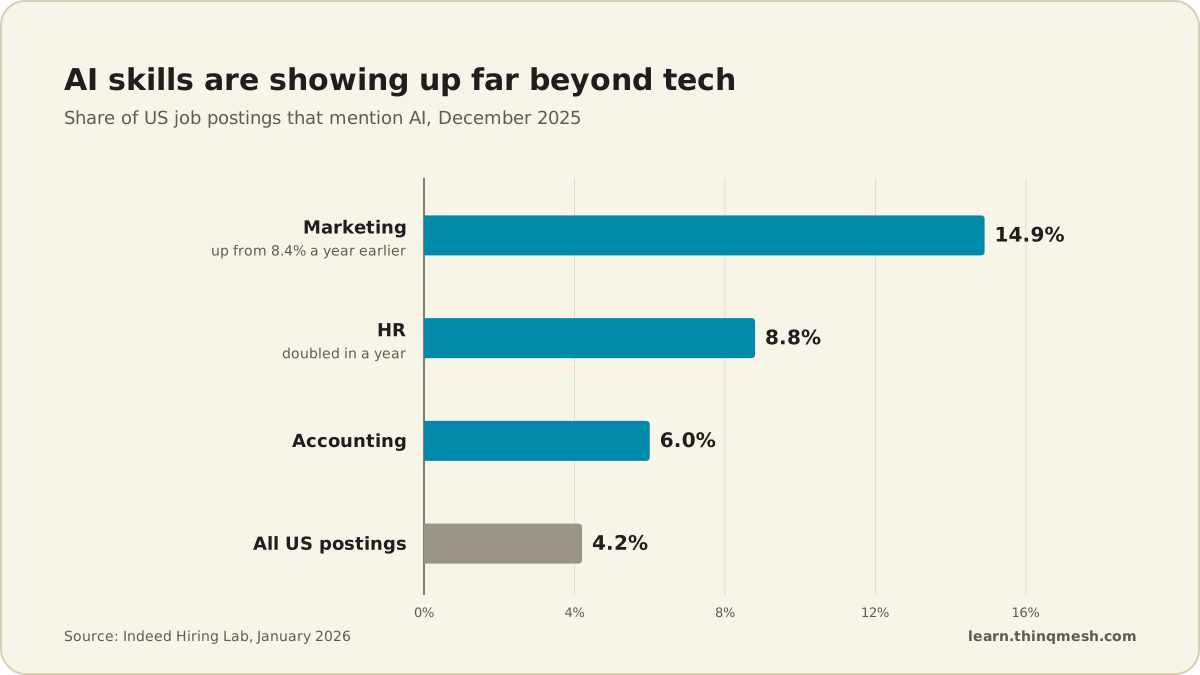
Marketing is the function where AI shows up most in job ads. In the US, 14.9% of marketing postings mentioned AI in December 2025, up from 8.4% a year earlier, against 4.2% of all postings (Indeed Hiring Lab, 2026).
The time savings are real but uneven. HubSpot found about a third of marketers save 10 to 14 hours a week and another third save more than 15. The share who say they understand how to use AI in marketing rose to 68.2%, from 47%. That still leaves roughly a third of the profession using tools they do not fully understand.
The payoff is showing up where it counts. In McKinsey's 2026 survey, revenue gains from AI were most often attributed to marketing and sales (McKinsey, 2026). Closer to home, a study of 3,249 Indian MSMEs by Google and the India SME Forum reported a 23% conversion uplift from AI marketing (Outlook Business, 2026).
What the day-to-day work looks like with AI
HubSpot names personalised content at scale as the number one trend. Adobe found more than 8 in 10 marketers update campaigns every week (Adobe, 2026). That pace is only possible with help. Here is what it can look like in practice. These are illustrations, not survey findings.
- A content lead at a Pune D2C brand drafts one festive-season campaign brief, then asks AI for versions in Hindi, Marathi and English, each tuned for Instagram, email and WhatsApp. She spends her time on the three that matter most, not on the first drafts.
- A performance marketer in Gurugram pastes a week of ad results into an AI assistant (with client names removed) and asks it to group the ads by message angle and spot which angles are tiring. He checks the maths himself before acting.
- A B2B marketer at a SaaS firm turns a 40-minute customer interview transcript into a case-study draft, five LinkedIn posts and a sales one-pager in an afternoon.
In each case, AI does the volume. The marketer does the choosing.
1.Brief well
Audience, one action, brand voice, what to avoid.
2.AI does the volume
Versions by language, channel and angle.
3.Choose and edit hard
Drop what sounds like everyone else; sharpen.
4.Verify before it ships
Every number, claim and quote checked at source.
The skills to build
Tool familiarity is the entry ticket. The skills that separate good work from average work are more specific.
Briefing well. AI output is only as good as the brief. Give it the audience, the one thing you want them to do, the brand voice with examples, and what to avoid. A vague prompt gets generic copy.
Editing hard. An AI first draft is a starting point, not a finished piece. The quality comes from a person who knows what good looks like and keeps pushing: cutting filler, sharpening the claim, adding the detail only you know.
Fighting sameness. In a BCG experiment, people using AI did about 40% better on creative product innovation, but the diversity of their ideas was 41% lower (BCG, 2023). If every competitor asks the same tool the same question, every campaign starts to sound alike. Your job is to push past the first answer.
Reading data with AI, not trusting it blindly. Use AI to summarise and group results, then verify the numbers before anyone sees them.
Try this week
Take one campaign you ran last quarter. Ask an AI assistant for ten new angles on the same product. Throw out the seven that sound like everyone else. Rewrite the best three in your brand's voice, then show all three to a colleague without saying which came from AI. Notice which edits made the difference.
What stays human, and the risks
The biggest risk is not bad AI. It is unchecked AI. KPMG and the University of Melbourne found 66% of employees rely on AI output without evaluating it, and 56% have made mistakes because of AI (KPMG, 2025). In marketing, that looks like a wrong price in an ad, an invented statistic in a blog post, or a claim your legal team never approved.
There is also "workslop": AI-generated content that looks good but lacks substance. 40% of US desk workers received some in the past month, and each instance took about two hours to fix (BetterUp Labs & Stanford, 2025). A glossy deck with nothing to say is still a waste of everyone's time.
Brand consistency is a real worry too. 84% of creatives in Adobe's survey said they worry about it. Keep a short brand guide, with examples of what you would and would not say, and give it to the AI every time.
Finally, protect data. Customer lists, unreleased plans and client names do not belong in a public AI chatbot. Use the tools your company has approved.
What stays human: knowing your customer, choosing the one idea worth backing, and deciding what your brand will never say. Microsoft's 2026 research ranked quality control of AI output (50%) and critical thinking (46%) as the most important human skills (Microsoft Work Trend Index, 2026).
What to do next
- Audit your week. List the tasks that took the most hours last week. Pick two that are mostly first drafts or reformatting and try them with AI.
- Write a one-page brand brief for AI: voice, audience, banned phrases, three examples of good copy. Reuse it in every prompt.
- Set a checking rule. No AI-written number, claim or quote goes out without a person verifying it at the source.
- Spend the saved hours on customers. Use at least some of the time AI gives back for customer calls, research or testing, the work AI cannot do for you.
If you want to build these habits with others, AI Fluency is taught live in small cohorts, with a project you keep at the end of each month. See the programme.