
27 Sept 2026AI CareersAI Skills Gap
Why everyone should skill up with AI, whatever their job
AI skills are wanted in every role, pay more and are scarce in India. The gap is not access to tools but training. Here is the evidence, in one place.
Author: Team Thinqmesh · 8 min read
- ChatGPT
- Claude
- Gemini
- Notion
- Google Sheets
- Slack
- Canva
Workers with AI skills now earn an average wage premium of 62%, according to PwC's 2026 Global AI Jobs Barometer (PwC, 2026). In India, AI job openings could pass 2.3 million by 2027, against a talent pool of about 1.2 million (Bain, 2025). Those two numbers make the case on their own. AI skill is scarce, it is paid for, and it is no longer only for engineers.
This post pulls the evidence together. Each section is short and links to a longer post if you want the detail. The thread running through all of it is simple: most people already have access to AI tools. What they lack is training in how to use them well.
The demand is broad. The World Economic Forum says AI and big data top the list of fastest-growing skills, and two-thirds of employers plan to hire people with specific AI skills (WEF, 2025). LinkedIn data shows a 70% year-on-year increase in US roles that require AI literacy, and 1.3 million new AI-related jobs worldwide in two years (WEF Stories, 2026). AI literacy was the top skill on LinkedIn's 2025 Skills on the Rise list (CNBC, 2026). Not AI engineering. Literacy, the kind everyone needs.
AI skills pay more, and the premium is growing
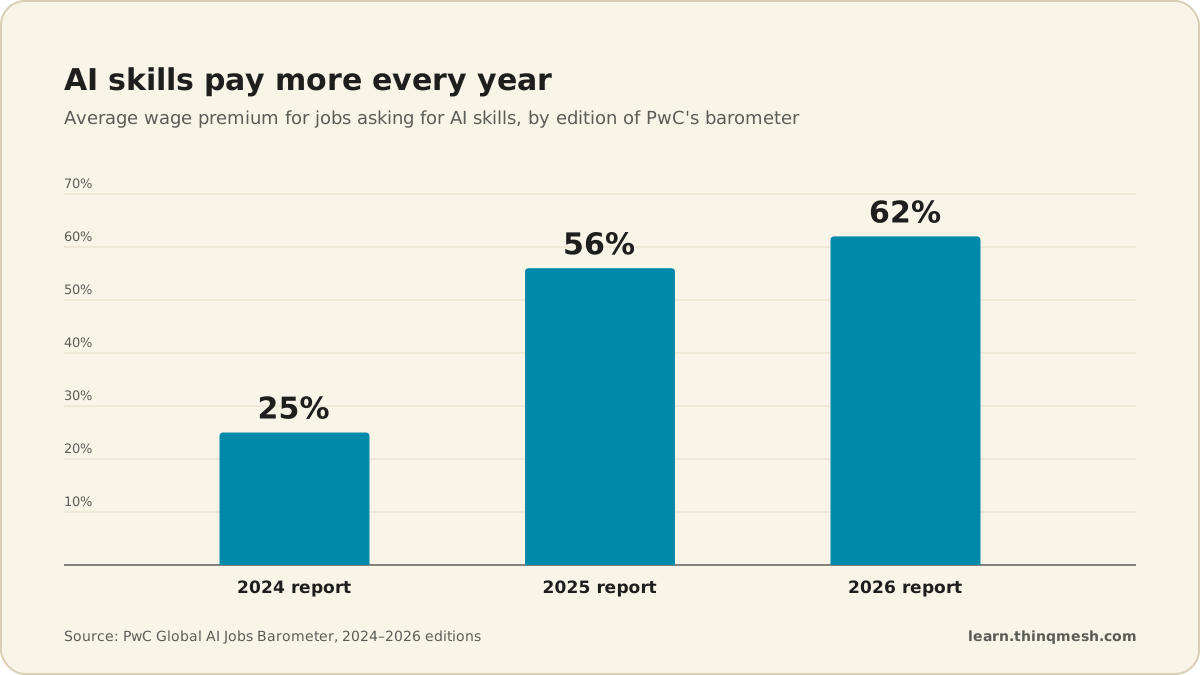
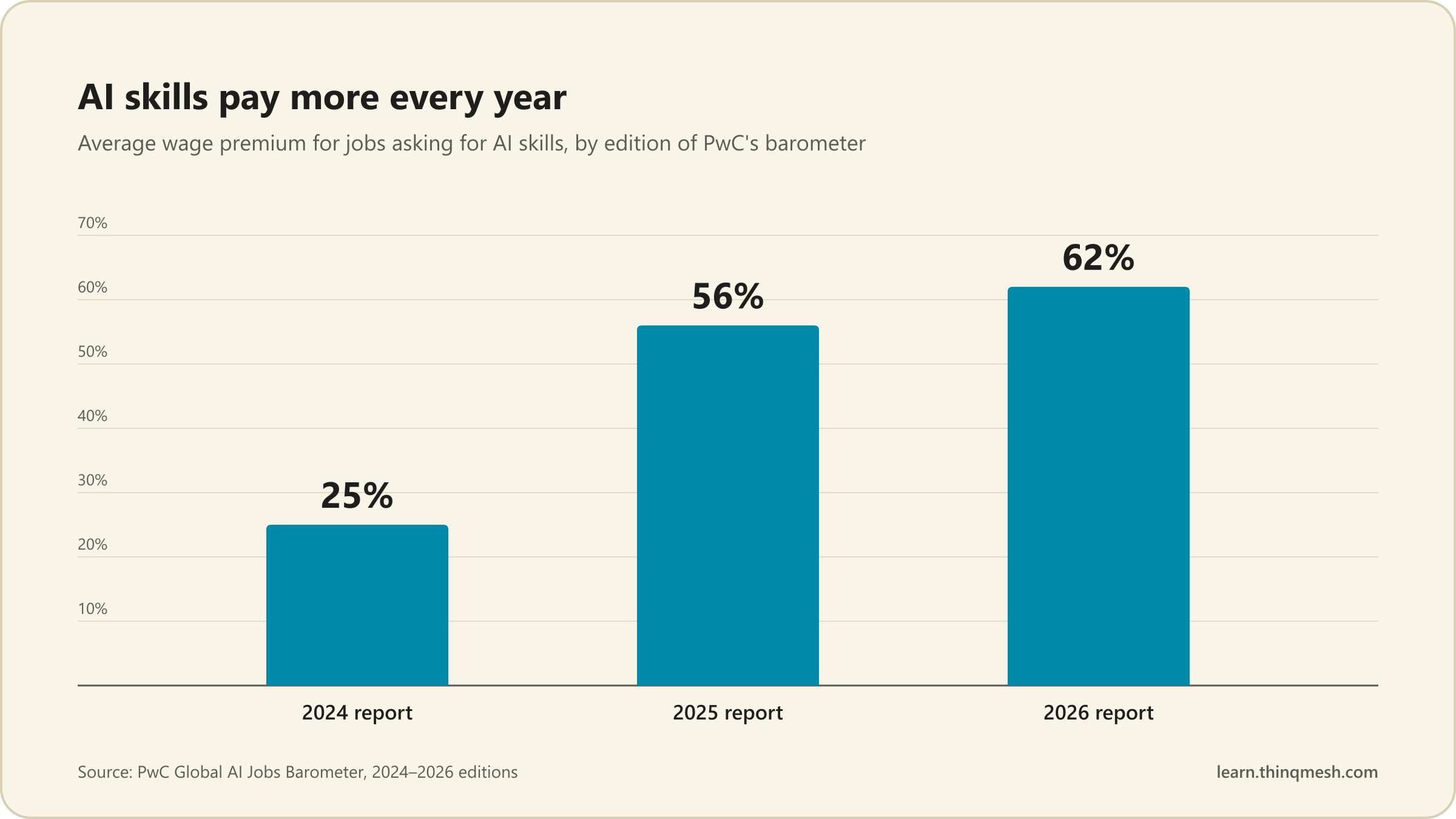
PwC has tracked the pay gap between jobs that ask for AI skills and similar jobs that do not. Its 2024 report found a 25% premium. The 2025 report found 56%, "double the 25% in the previous year" (PwC, 2025). The 2026 report puts it at 62%, and says that is up from 57% the year before (PwC, 2026).
The number of jobs asking for AI skills grew 69% in PwC's latest data, about eight times faster than the overall job market (PwC, 2026). Lightcast, looking at US postings, found that roles listing AI skills offer 28% higher salaries (Lightcast, 2025). The full picture, including which kinds of AI skill are paid for, is in AI skills pay more.
India needs far more AI-skilled people than it has
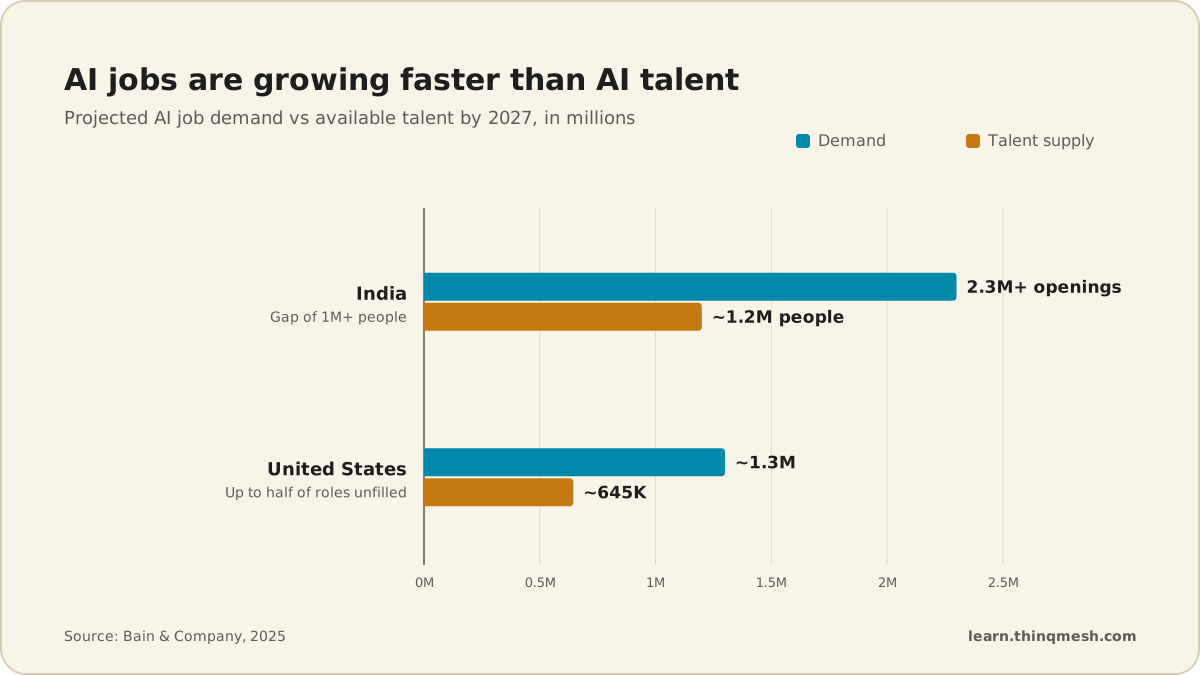
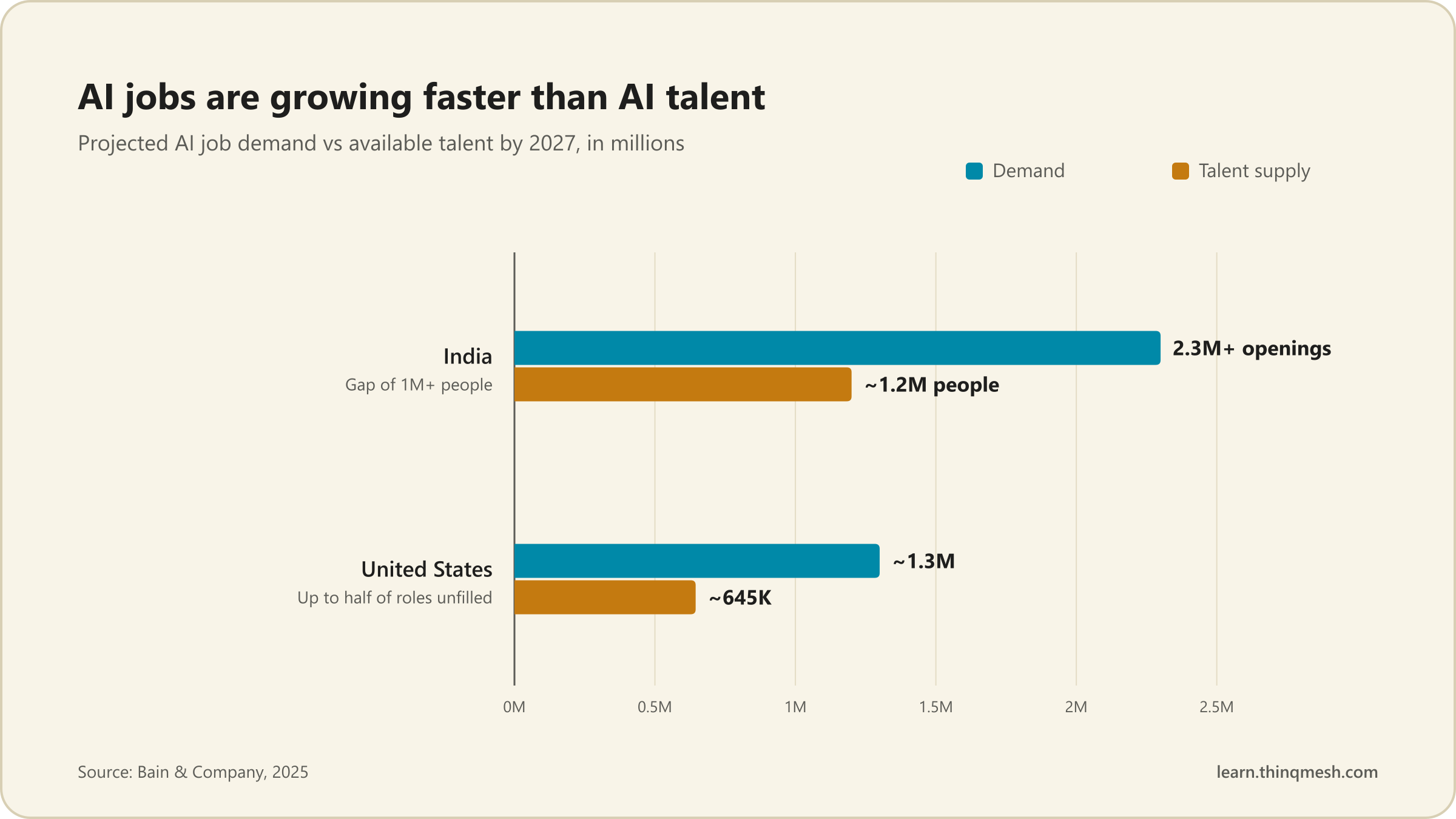
Bain estimates India could surpass 2.3 million AI job openings by 2027, with a talent pool of about 1.2 million. It adds that more than a million people will need reskilling to close the gap (Bain, 2025).
Employers feel it. In an EY India study, 97% of executives named a lack of talent as a primary hurdle, and only 3% said they had enough in-house (EY India, 2025). Hiring is already moving: LinkedIn reports AI talent hiring in India up 59.5% year on year (Business Standard, 2026). NITI Aayog has recommended making AI literacy a foundational skill for the country (PIB, Oct 2025). We unpack the numbers in India's AI skills gap, explained.
In a 2026 NASSCOM and Indeed study, 40% of Indian employers said they prefer demonstrable AI skills or certifications over a degree. The same study found 58% get too few applicants and 50% see a skills mismatch (NASSCOM & Indeed, 2026). Globally, 71% of leaders told Microsoft and LinkedIn they would rather hire a less experienced candidate with AI skills than a more experienced one without (Work Trend Index, 2024).
That is an opening for anyone willing to learn. What counts as "demonstrable" is covered in Employers now prefer AI skills over degrees.
It is not only a tech job
Lightcast found that 51% of job postings asking for AI skills are outside IT and computer science (Lightcast, 2025). Indeed's US data shows the same pattern, function by function.
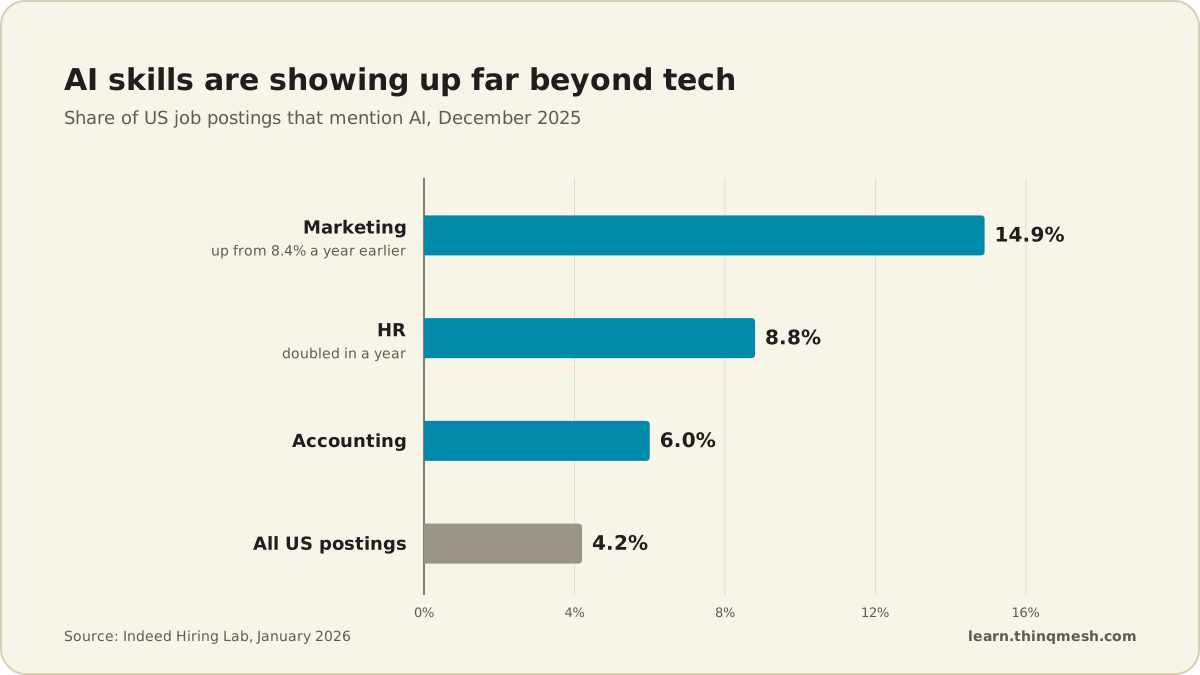
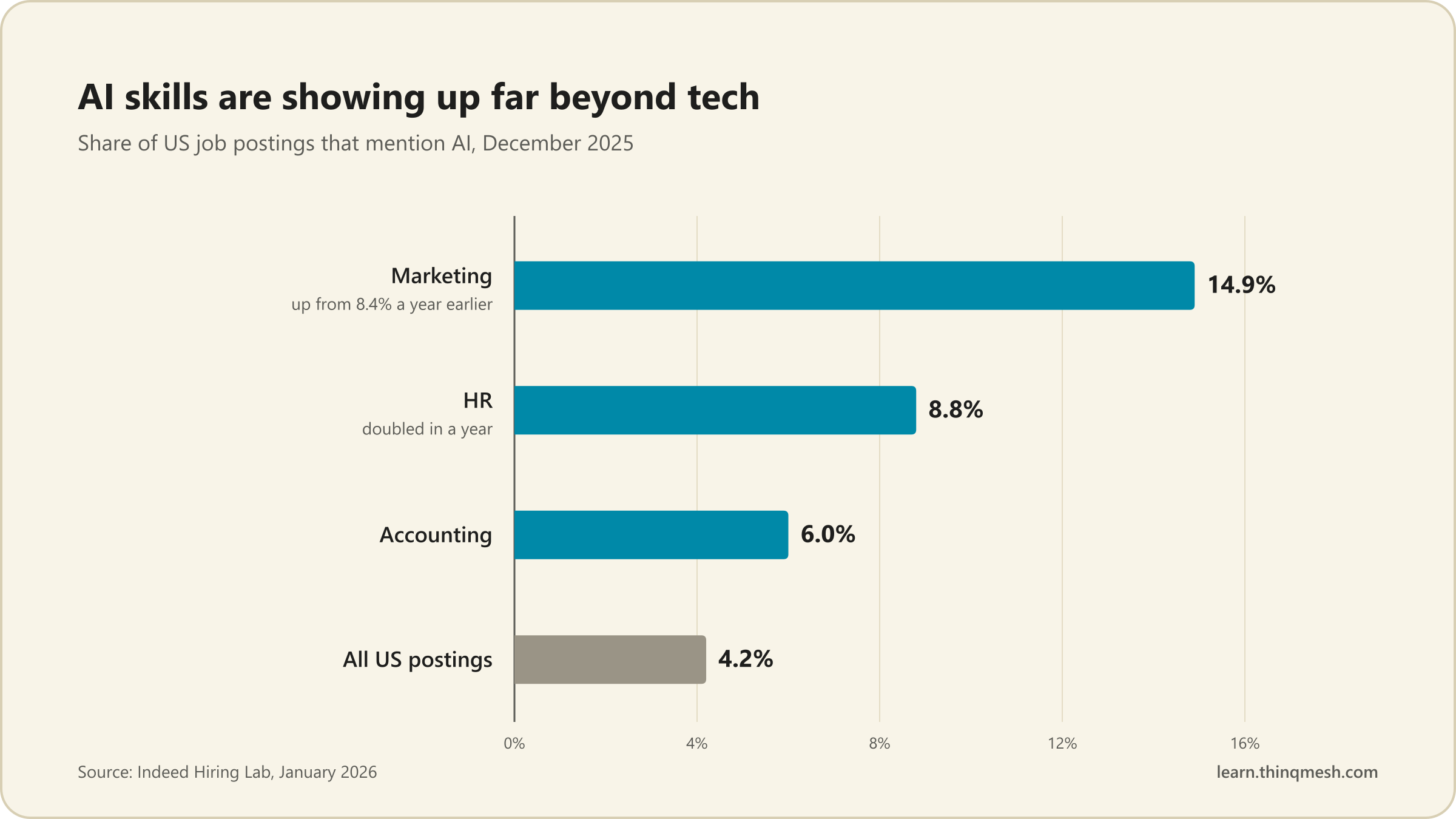
In the US, marketing postings mentioning AI rose from 8.4% to 14.9%, and HR postings doubled to 8.8% (Indeed Hiring Lab, 2026). If you work in a non-technical role, read You don't need to work in tech.
Every industry and every role is moving
EY India expects generative AI to lift productivity in Indian banking operations by up to 46% by 2030, in pharma by 35–40%, in retail by 35–37% and in healthcare by 30–35% (EY India, 2025). Those gains only arrive if the people doing the work know how to use the tools. A bank can buy software in a quarter. Teaching thousands of branch and operations staff to use it well, and to check what it produces, takes much longer. That second part is where most organisations are stuck, and where trained people stand out.
1.Buy the tools
A bank can buy software in a quarter.
2.Teach people to use them
The slow part, where most organisations are stuck.
3.Check what AI produces
Staff learn to spot when an answer is wrong.
4.Gains arrive
Only once the people doing the work know how.
We have written a post for each major sector: healthcare, banking and insurance, retail and e-commerce, manufacturing, teaching, legal and agriculture. Each one sticks to what Indian organisations are actually doing.
The same shift shows up job by job. HubSpot reports that 86.4% of marketing teams use AI (HubSpot, 2026). Salesforce says 87% of sales organisations do (Salesforce, 2026). KPMG found active AI use in finance rose from 30% in 2024 to 75% in 2026 (KPMG, 2026).
Find your own role: marketers, sales, HR and recruiters, customer support and BPO, software engineers, finance and accounting, creators and designers, small business owners and government.
Jobs are changing faster than they are disappearing
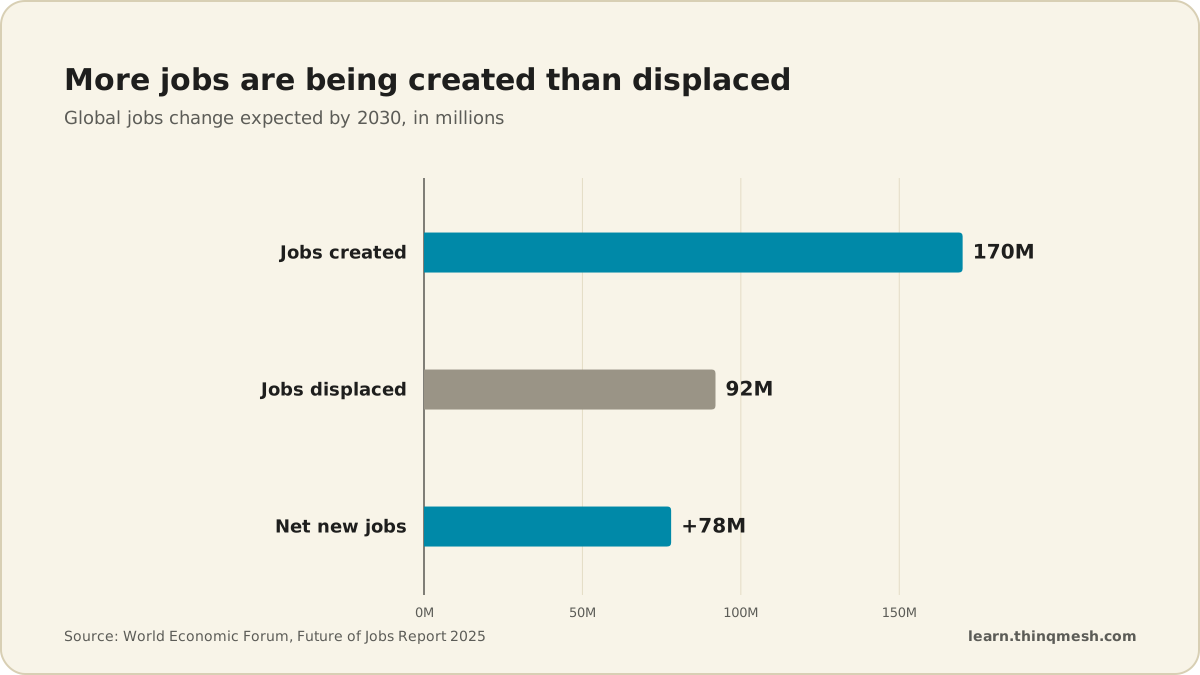
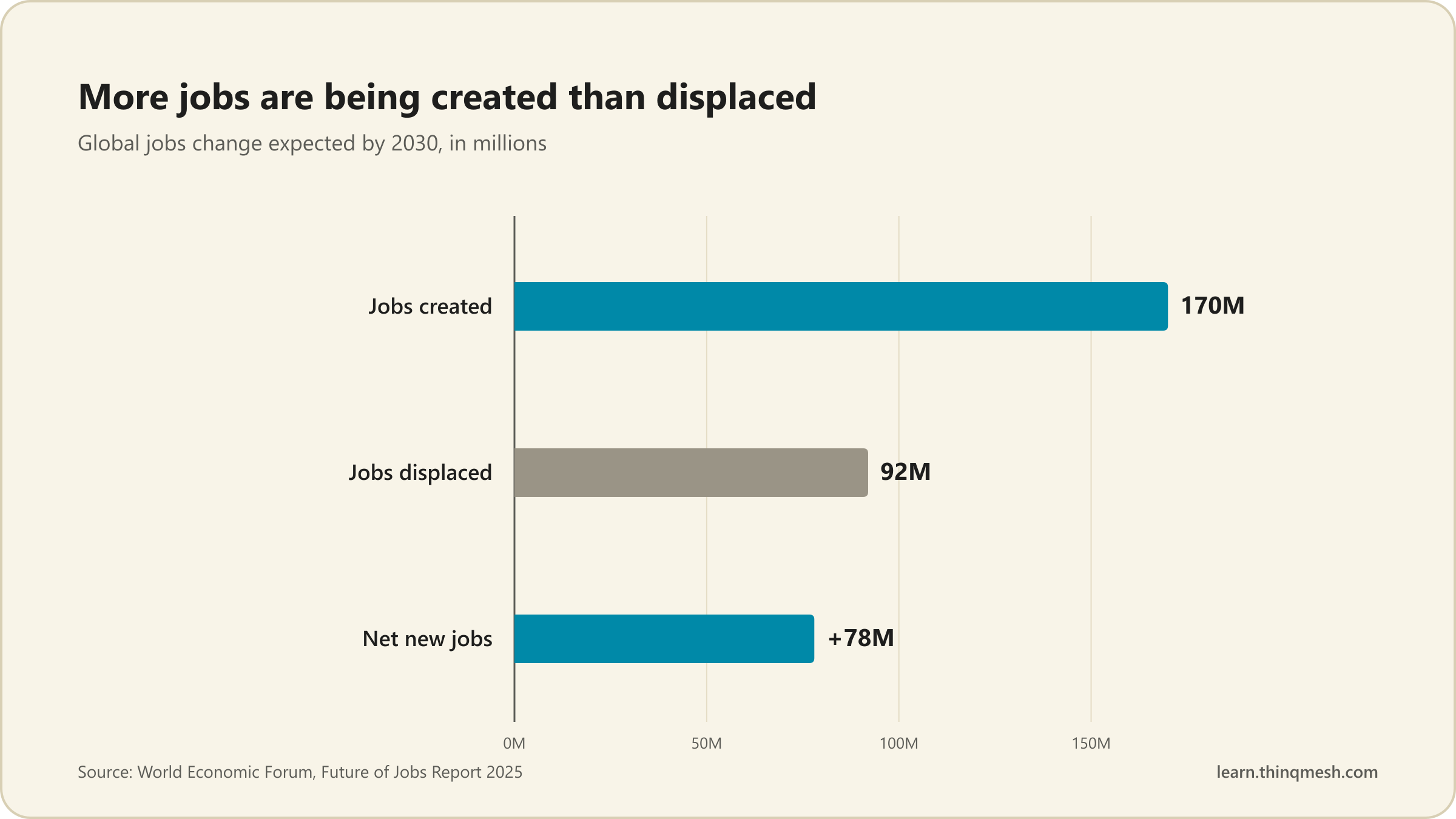
The World Economic Forum expects 170 million jobs to be created and 92 million displaced by 2030, a net gain of 78 million (WEF, 2025). The catch is in the same report: 59 of every 100 workers will need training by 2030, and 63% of employers call skill gaps the biggest barrier to change.
Employers expect 39% of core skills to change over the same period, and 85% plan to prioritise upskilling their workforce. In other words, most jobs will survive, but the way they are done will not stay the same. The people who adapt early will have the easier time.
The IMF puts it plainly. Almost 40% of global employment is exposed to AI, and workers who can harness it see productivity and wage gains while those who cannot fall behind (IMF, 2024).
Having the tools is not the same as knowing how to use them
Access is not the problem. In Microsoft and LinkedIn's 2024 survey, 75% of knowledge workers already used AI, and 78% of them brought their own tools. Only 39% had received AI training from their company (Work Trend Index, 2024). Occasional use is common, but habit is not. Gallup found 45% of US employees use AI at work at least a few times a year, and only 10% use it daily (Gallup, 2025). BCG found only a third of employees say they have been properly trained (BCG, 2025).
Untrained use has a cost. A KPMG and University of Melbourne study of more than 48,000 people found 66% rely on AI output without evaluating it, and 56% have made mistakes at work because of AI (KPMG & University of Melbourne, 2025). Training changes the picture. Slack found trained workers were up to 19 times as likely to report productivity gains (Slack, 2024).
The skill that matters most
Microsoft's 2026 Work Trend Index found workers rank quality control of AI output (50%) and critical thinking (46%) as the most important human skills (Microsoft, 2026). Knowing when the answer is wrong is the skill.
We go deeper in Having AI tools is not knowing AI and Five hours of AI training, which looks at BCG's finding that regular use rises sharply with at least five hours of training plus in-person coaching.
What to do next
- Pick one task you do every week, such as a report, an email batch or a spreadsheet clean-up, and try it with an AI assistant. Note what it got right and what you had to fix.
- Read the post for your role or industry from the lists above, and write down two tasks in your own job that AI could help with.
- Check every AI answer you use at work this month against a source you trust. It builds the habit that matters most.
- Start a small portfolio: one real piece of work you improved with AI, with a short note on how you checked it.
- Find people to learn with. A group keeps you practising after the first week.
If you want structure, AI Fluency is taught live in small cohorts, with a project you keep at the end of each month. See the programme or get started.