
20 Sept 2026Using AI WellAI Fluency
What five hours of AI training can change
BCG found regular AI use rises sharply after at least five hours of training plus coaching. Here is what those first five hours should cover.
Author: Team Thinqmesh · 5 min read
- ChatGPT
- Claude
- Gemini
- Notion
- Zoom
In a survey of more than 10,600 people, BCG found that regular AI use was sharply higher among those who had received at least five hours of training plus in-person coaching (BCG, 2025). Five hours is not much. It is less than a working day. Yet most people using AI at work have not had even that. This post looks at why a small amount of good training makes such a difference, and what those first five hours should actually cover.
Most people have not had five hours
The training gap is wide, whichever survey you read.
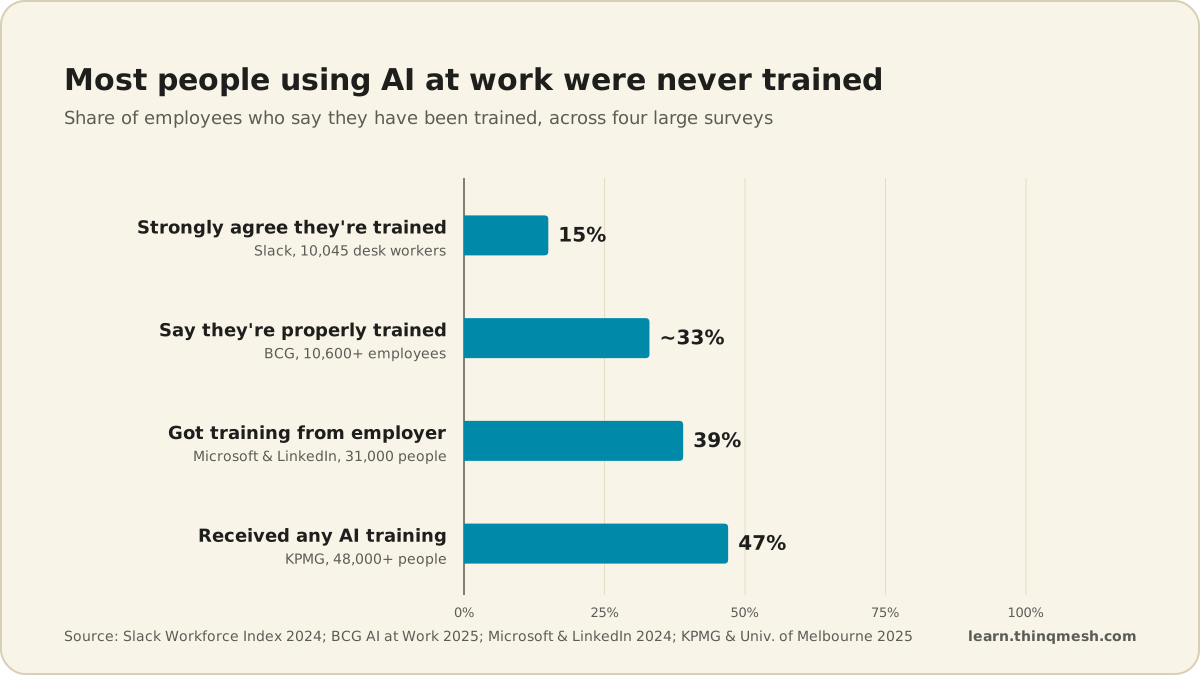
Only about one-third of employees say they have been properly trained (BCG, 2025). Only 15% of desk workers strongly agree they have the training to use AI effectively (Slack, 2024). Only 47% have received any AI training at all (KPMG & University of Melbourne, 2025).
Meanwhile, most people are already using it. 75% of knowledge workers use AI, but only 39% of them got training from their company (Microsoft & LinkedIn, 2024).
What training changes
The difference between trained and untrained users is large. In Slack's survey of 10,045 desk workers, trained workers were up to 19 times as likely to report productivity gains from AI, and 7 times as likely to trust it (Slack, 2024).
Regular use matters too. Slack's later research found that daily AI users were 64% more likely to report very good productivity, and reported 81% greater job satisfaction (Slack, 2025). BCG saw the other side: without that support, regular use among frontline employees has stalled at 51% (BCG, 2025).
Surveys like these show association, not proof that training alone causes the gains. People who seek out training may already be keen. But the pattern is consistent across very different studies, and it matches what controlled experiments show about skill mattering more than access.
Why coaching, not just a video
Notice the second half of BCG's finding: five hours of training plus in-person coaching. That detail matters.
A video can show you features. It cannot look at the prompt you just wrote and tell you why the answer came back generic. It cannot notice that you accepted a made-up statistic. Coaching closes the loop between trying something and understanding why it worked or did not.
You + a coach
1.Try something
Write a prompt for a real task.
2.Get feedback
A coach looks at what you just wrote.
3.Understand why
Why the answer worked, or came back generic.
4.Try again
Use what you learned on the next attempt.
…then back to step 1
1.Try something
Write a prompt for a real task.
2.Get feedback
A coach looks at what you just wrote.
You + a coach
4.Try again
Use what you learned on the next attempt.
3.Understand why
Why the answer worked, or came back generic.
There is research support for learning actively rather than passively. In a randomised trial on learning a coding skill, the group using AI scored 50% on a follow-up quiz against 67% for those without it. The people who asked the AI for explanations, rather than just answers, kept learning (Anthropic, 2026). Good training teaches you to use AI in a way that builds your own skill instead of replacing it.
Organisations have a part to play
Individual training is only half of it. Workers at companies that actively promote AI are nearly three times more likely to be power users (Slack, 2025).
Ethan Mollick, who studies AI at work, warns that "AI use that boosts individual performance does not naturally translate to improving organizational performance" (Mollick, 2025). In Denmark, workers reported productivity benefits from AI but null effects on earnings and hours (NBER, Humlum & Vestergaard). Teams need shared habits, clear data rules and a way to pass on what works.
Many employers know this. 47% of leaders list upskilling existing employees as a top workforce strategy (Microsoft Work Trend Index, 2025). But in 2024 only 25% of companies planned generative-AI training that year (Microsoft & LinkedIn, 2024). If your employer has not got there yet, you do not have to wait.
What the first five hours should cover
Five hours goes quickly. Here is how we would spend it, based on the gaps these studies keep finding.
1.Hour 1: how tools behave
Why a model sounds confident when it is wrong.
2.Hour 2: context
Give what a new colleague would need.
3.Hour 3: verification
Check facts, figures and references.
4.Hour 4: tasks and data
Sort your work; know what stays out.
5.Hour 5: a real project
One task end to end, with a coach.
Hour 1: how these tools actually behave. What a model is doing when it answers, why it sounds confident when it is wrong, and why it does some hard tasks well and some easy ones badly. This is the "jagged frontier" that BCG and Harvard researchers described.
Hour 2: context. Most weak answers come from weak requests. Practise giving the tool what a new colleague would need: the goal, the audience, the background, an example of good output, and the limits.
Hour 3: verification. 66% of people rely on AI output without evaluating it (KPMG & University of Melbourne, 2025). Practise checking facts, figures and references against sources, and spotting invented citations.
Hour 4: choosing tasks and keeping data safe. Sort your own weekly work into tasks worth handing over and tasks to keep. Learn what may and may not go into a public tool, and why.
Hour 5: a real project. Take one task from your actual job and do it end to end with AI, with a coach looking at your work. As an illustration, a teacher might build a week of lesson plans for a real class, or a recruiter might draft and check job descriptions for three open roles. Leave with something you will use on Monday.
What matters most is that every hour uses your real work, not toy examples, and that someone gives you feedback.
What to do next
- Block five hours in your calendar this month for deliberate AI practice. Spread them across two weeks.
- Choose one real task from your job to use as your practice project.
- Find a partner or group. Practising with others, and seeing their prompts, speeds up learning.
- Keep a log of what worked, what failed and what you had to fix.
- Ask your employer whether AI training is planned. If it is not, share this post.
If you want those first hours taught live, with coaching on your own work, AI Fluency runs in small cohorts with 8 live sessions a month and a project you keep each month. You can start here or read about the programme.