
26 Sept 2026Teaching
Why every course is taught live
Recorded video is convenient, and it is why most people never finish. The research on AI training points to live teaching, practice and review.
Author: Team Thinqmesh · 4 min read
- Zoom
- Google Meet
- Slack
- Notion
- Loom
Only about one in three employees say they have been properly trained to use AI, according to BCG's survey of more than 10,600 people (BCG, 2025). The same study found what closes the gap: regular use is sharply higher among people who get at least five hours of training and in-person training and coaching. That finding is why every Thinqmesh Academy course is taught live.
What the research says about training
Learning at your own pace is comfortable, and comfort is the problem. A recording never notices when you stop watching. The research on AI training keeps pointing at the same thing: time, practice and a person who helps.
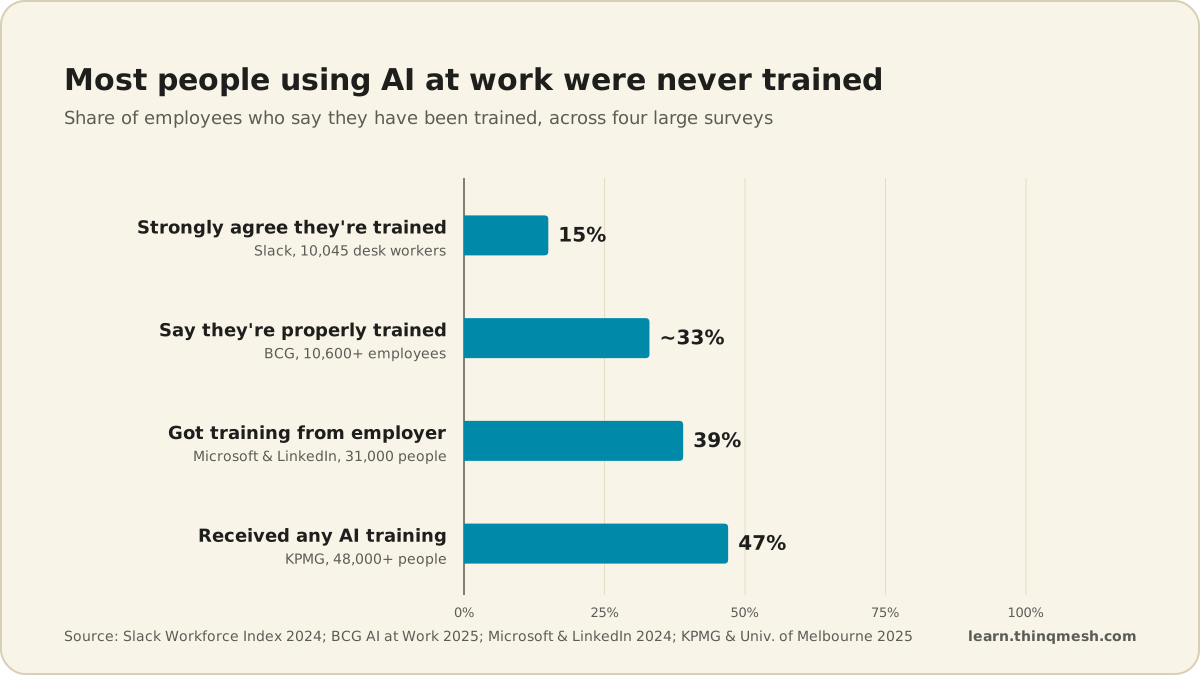
Slack's survey of 10,045 desk workers found only 15% strongly agree they have the training to use AI effectively. The trained ones were up to 19 times as likely to report productivity gains, and 7 times as likely to trust AI (Slack, 2024). Microsoft and LinkedIn found only 39% of AI users had received training from their company (Microsoft & LinkedIn, 2024), and KPMG and the University of Melbourne found 47% had received any AI training at all (KPMG & University of Melbourne, 2025).
Using AI is not the same as learning
There is a subtler finding too. In a randomised trial published by Anthropic, people who used AI assistance while learning a new coding skill scored 50% on a follow-up quiz, against 67% for those who worked without it. But the people who asked the AI for explanations, rather than just answers, kept learning (Anthropic, 2026).
That is the idea behind how we teach. A tool can hand you an answer. It takes a habit of asking why, and someone who pushes you to ask it, to turn answers into skill. A live session is where that habit gets built: an instructor who asks why your agent failed, and a group that hears the answer with you.
A register changes behaviour
Our sessions are taught live on fixed dates, two a week, with a register. Somebody notices when you stop turning up, and that, more than any feature, is why people finish.
Each session has a short brief on its page. It is not the lesson itself, because the lesson is taught live. It tells you three things: what the session covers, what you will be able to do afterwards, and how to prepare. Before you join, we ask you to do any setup the day before (setup problems eat time that belongs to the whole group), bring one question from the last session, and join a few minutes early, because sessions start on time and attendance is recorded.
1.Do setup the day before
Setup problems eat the whole group's time.
2.Bring one question
From the last session.
3.Join a few minutes early
Sessions start on time; attendance is recorded.
4.Learn live with the group
Ask why, and hear the answers together.
If you miss one, you tell your group in Communities and ask what you missed. Your group moves through the course together, so it is the best place to catch up.
Small groups, on purpose
Every course runs in monthly groups of 25. Live sessions, the group discussion and mentor attention do not scale, so the number is kept small on purpose. We would rather say so than pretend otherwise.
Your lessons open the day you enrol. The group is who you learn alongside, not when you are allowed to start reading. Each group also has its own space in Communities for questions, session notes and project reviews.
You pass by building
There is no multiple-choice test at the end of a video. In AI Fluency, the last two sessions of every month are one project across two days. On day one you build from the plan you made in the session before, with review as you go, not after. On day two you fix what day one exposed, finish, and demonstrate what you built.
Then a senior engineer opens your work and writes back: what is good, what is wrong, and what to do next. Across the three months, that is three finished projects: a First Line Agent, an Agentic Workflow, and an Autonomous Loop, deployed.
1.Plan in the session before
The plan you build from on day one.
2.Day one: build
With review as you go, not after.
3.Day two: fix and finish
Fix what day one exposed, then demonstrate.
4.Senior engineer review
What is good, what is wrong, what next.
A certificate says you turned up. Work an employer can open says far more. That is why we keep the projects, and why we ask you to.
What live teaching is not
Live does not mean slow, and it does not mean lectures. Most of the value is in the parts a video cannot do: noticing when you are stuck, answering the question you brought, and reading what you built. The research above says training works when it has enough hours and a person in it. We designed the Academy around both.
If you are deciding whether live teaching suits you, read how the Academy works and how project sessions run, then look at AI Fluency.