
26 Sept 2026Using AI Well
Having AI tools is not the same as knowing AI
Most knowledge workers already use AI, but only about a third say they were properly trained. Access is common. Skill is not, and the gap shows.
Author: Team Thinqmesh · 6 min read
- ChatGPT
- Claude
- Gemini
- GitHub Copilot
- Perplexity
Three in four knowledge workers already use AI at work, and 78% of them bring their own tools (Microsoft & LinkedIn, 2024). Yet only about a third say they have been properly trained (BCG, 2025). Having a tool open in a browser tab is not the same as knowing how to use it. This post looks at what that gap is, what it costs, and how to close it for yourself.
Everyone has access now
A few years ago, using AI at work meant a special project and a budget. Today it means opening a free app on your phone. The Microsoft and LinkedIn Work Trend Index found that 75% of knowledge workers use AI, and most of them did not wait for their employer to hand them anything (Microsoft & LinkedIn, 2024).
India looks the same from the inside. In a NASSCOM and Indeed study, 73% of Indian employees said they learn AI through self-driven channels (NASSCOM & Indeed, 2026). That is a lot of people teaching themselves, one video and one experiment at a time.
Self-teaching is a good instinct. The trouble is what it tends to leave out.
Training has not kept up
Here is what four large surveys say about who has actually been trained.
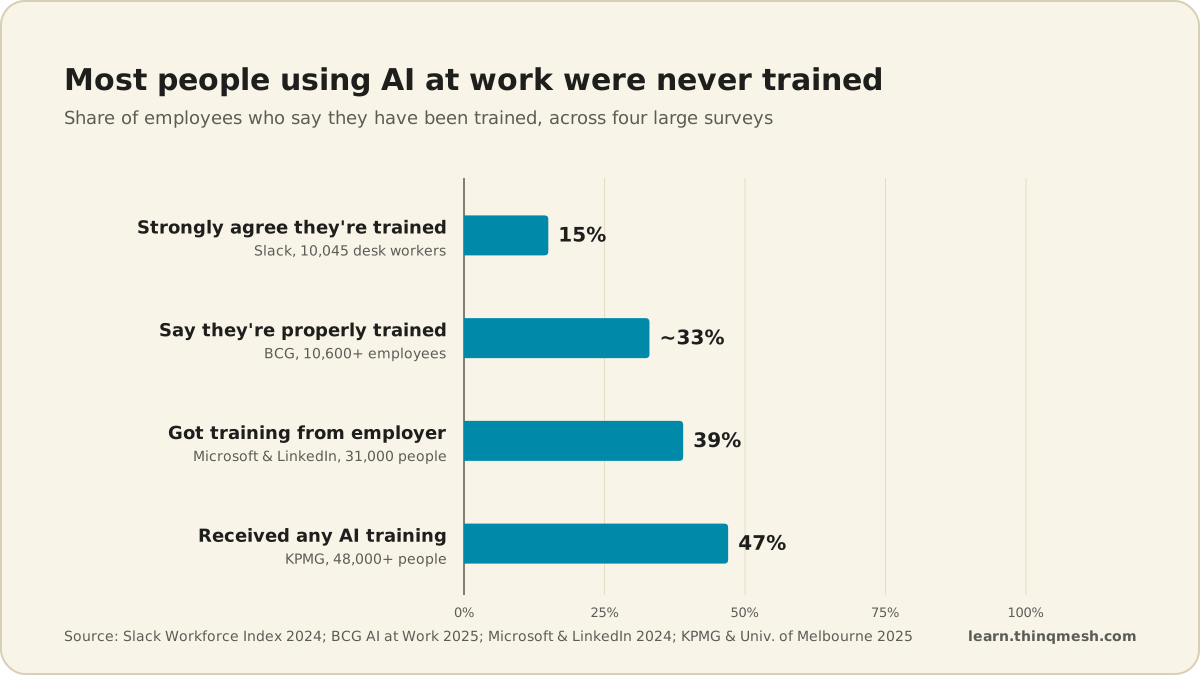
- Only 15% of desk workers strongly agree they have the training to use AI effectively (Slack, 2024).
- About one-third say they have been properly trained (BCG, 2025).
- Only 39% of AI users got AI training from their company, and only 25% of companies planned generative-AI training that year (Microsoft & LinkedIn, 2024).
- Only 47% of employees have received any AI training at all (KPMG & University of Melbourne, 2025).
The numbers differ because the questions differ. The direction does not. Most people using AI at work were never shown how to use it well.
What untrained use looks like
The KPMG and University of Melbourne study surveyed more than 48,000 people in 47 countries. Its findings read like a description of what happens when access runs ahead of skill (KPMG & University of Melbourne, 2025):
- 66% rely on AI output without evaluating it.
- 56% have made mistakes in their work because of AI.
- 57% hide their AI use.
Put those together. Most people do not check what the tool gives them, more than half have been caught out by it, and more than half do not tell anyone they used it. That last point matters. When use is hidden, nobody reviews it, nobody learns from the mistakes, and good habits never spread through a team.
Developers, who you might expect to be the most comfortable group, show the same tension. 84% use or plan to use AI tools, and 46% actively distrust their accuracy (Stack Overflow, 2025). Using a tool you do not trust, without a method for checking it, is tiring and risky.
Using AI sometimes is not using it well
There is also a gap between trying AI and making it part of how you work. In the US, 45% of employees use AI at work at least a few times a year, but only 10% use it daily (Gallup, 2025).
A few times a year is not a skill. It is a novelty. People try it, get a mediocre answer, and go back to the old way. The ones who get value tend to be the ones who learned what to ask, what context to give, and when not to use it at all.
BCG saw the same stall on the frontline: regular use among frontline employees has stalled at 51% (BCG, 2025).
Training changes the picture
The encouraging part is how much training moves the numbers. In Slack's survey of 10,045 desk workers, those who had been trained were up to 19 times as likely to report productivity gains from AI, and 7 times as likely to trust it (Slack, 2024).
BCG found that regular use is sharply higher among people who received at least five hours of training plus in-person coaching (BCG, 2025). Five hours is not a degree. It is a week of evenings.
Employers are also clear about which human skills now matter most. In Microsoft's 2026 survey, quality control of AI output (50%) and critical thinking (46%) ranked as the most important (Microsoft Work Trend Index, 2026). Those are exactly the skills that the KPMG numbers show are missing.
What "knowing AI" actually means
Knowing AI does not mean knowing how a model is built. For most people it means a handful of practical habits:
- Choosing the task. Some work AI does well, some it does badly while sounding confident. Knowing the difference is the first skill.
- Giving context. A one-line request gets a generic answer. The background, the audience, an example of good output and the constraints get a useful one.
- Checking the output. Every fact, figure, name and reference gets verified before it goes to anyone else.
- Keeping data safe. Knowing what you may and may not paste into a public tool.
- Being open about it. Telling your manager or client where AI helped, so the work can be reviewed properly.
1.Choose the task
Know what AI does well and what it gets wrong.
2.Give context
Background, audience, an example, the limits.
3.Check the output
Verify every fact, figure, name and reference.
4.Keep data safe
Know what stays out of a public tool.
5.Be open about it
Say where AI helped, so it gets reviewed.
As an illustration: a sales executive who drafts a proposal with AI and sends it as is has used a tool. One who gives it the client's actual brief, checks every price and claim, and tells their manager which parts AI drafted has used a skill. The first saves ten minutes. The second saves ten minutes and does not lose the client.
What to do next
- Take stock this week. List the three work tasks where you use AI most, and note whether you check the output every time.
- Pick one task to do properly. Write down the context you would give a new colleague for it, and give the AI the same.
- Build a checking habit. Before you send anything AI helped with, verify every number and every name against its source.
- Check your company's policy on what data may go into public AI tools. If there is none, ask.
- Set aside five hours of deliberate practice this month, on real work rather than toy examples.
If you would rather learn this with a teacher and a group, AI Fluency is taught live in small cohorts, with a project each month that you keep. See how it works.