
23 Sept 2026AI Careers
AI skills pay more, and the premium keeps growing
Workers with AI skills earn an average 62% wage premium, per PwC's 2026 barometer. Here is what the data shows, and which kinds of AI skill are paid for.
Author: Team Thinqmesh · 5 min read
- inLinkedIn
- ChatGPT
- Claude
- Notion
- Google Sheets
Jobs that ask for AI skills pay an average wage premium of 62%, according to PwC's 2026 Global AI Jobs Barometer (PwC, 2026). Two years earlier, PwC put the premium at 25%. Few skills have moved pay this far, this fast.
This post looks at the evidence on pay, where it comes from, what it does and does not tell you, and which AI skills employers and clients are paying for.
The premium, year by year
PwC compares jobs that require AI skills with similar jobs that do not. Its 2024 report found a 25% premium. The 2025 report said AI-skilled workers "see average 56% wage premium in 2024, double the 25% in the previous year" (PwC, 2025). The 2026 report puts the figure at 62% (PwC, 2026).
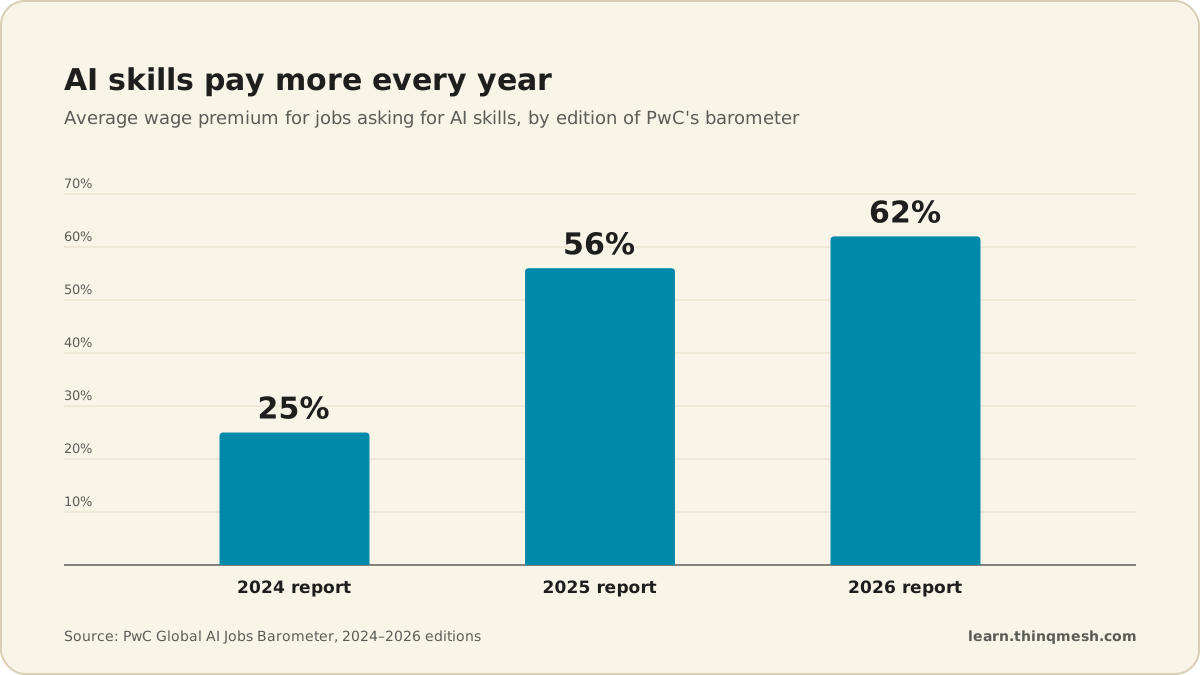
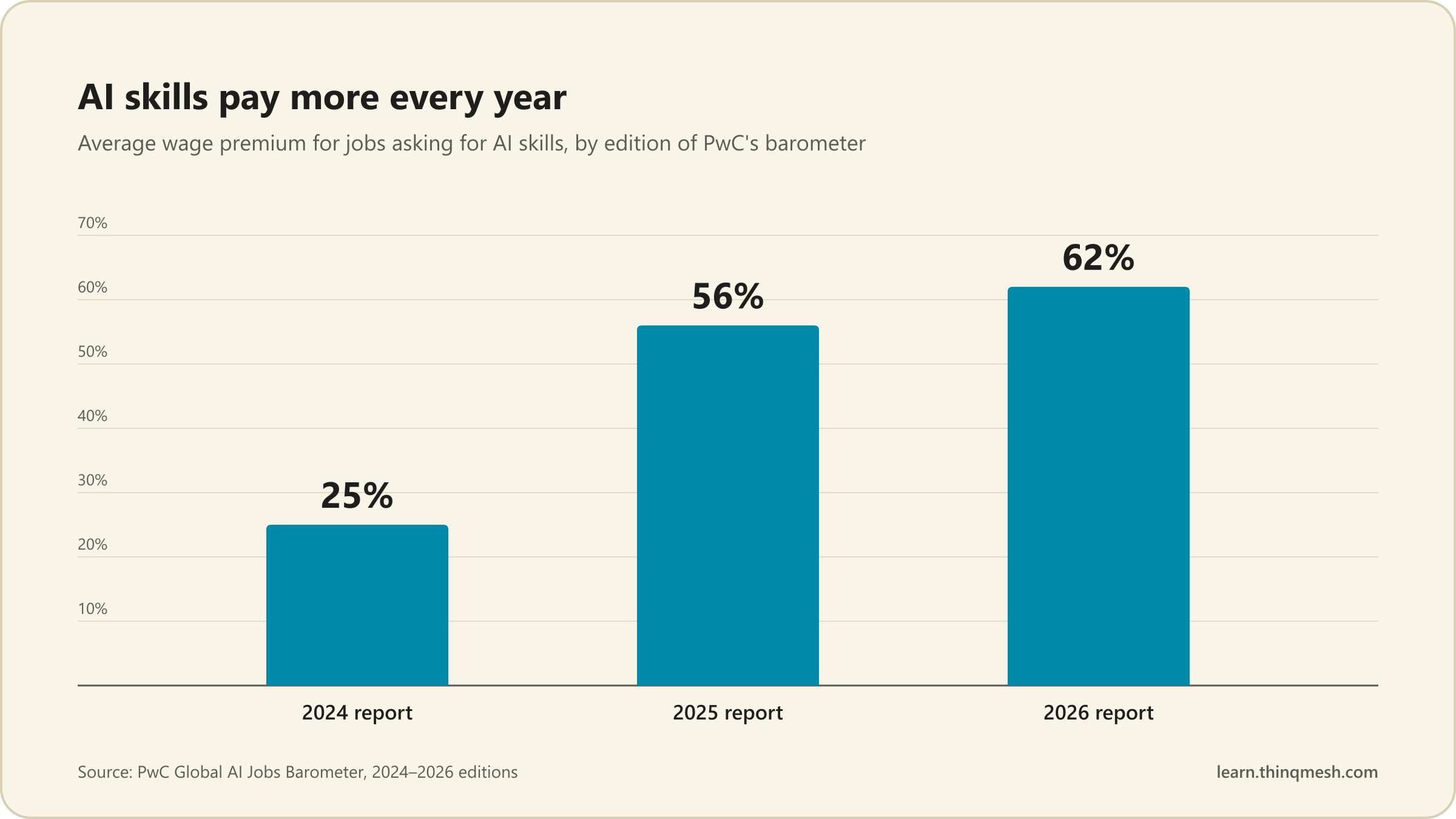
One small note on the numbers. The 2026 report describes its 62% as up from 57% the year before, while the 2025 report itself said 56%. Either way, the trend is the same. The chart uses the figure each report published.
These are global averages. PwC does not publish an India-specific premium, so treat them as a direction, not a salary promise.
Demand is growing much faster than the market
The premium exists because demand is outrunning supply. PwC found jobs needing AI skills grew 69%, about eight times the growth of the overall job market, which was 9% (PwC, 2026). The skills in the most AI-exposed jobs are also changing more than twice as fast as in other jobs.
PwC reports two more findings worth knowing. Productivity growth is 40% higher at the companies most exposed to AI. And the most AI-exposed junior roles are seven times more likely to ask for skills that used to be expected only of senior staff. Entry-level jobs now expect more.
A second source: US job postings
Lightcast, which analyses job postings, found US roles listing AI skills offer 28% higher salaries, nearly $18,000 more a year (Lightcast, 2025). It also found that 51% of postings asking for AI skills are outside IT and computer science. The premium is not reserved for engineers.
Lightcast's more recent data shows how quickly the specific skills shift. Mentions of agentic AI skills went from 0.06% to 0.23% of US postings in a single year (Lightcast, 2026). Small numbers, but nearly a fourfold rise.
Freelancers see it too
Upwork's 2026 Future Workforce Index, which covers US workers only, found freelancers doing AI work earn 34% more per hour. Earnings for complex, AI-augmented work rose 45% (Upwork, 2026). Upwork also describes an emerging "AI Orchestrator" role, someone who coordinates AI tools to deliver a finished piece of work.
The same report carries a warning. Contracts for generative AI and creative production rose 90%, but earnings for that work fell 13%. When a task becomes easy to do with AI, it also becomes cheaper to buy.
Which AI skills are paid for
That warning points to the real lesson. The premium goes to people who use AI to do harder, more valuable work, not to people who can produce a quick first draft.
Upwork's in-demand skills data for 2026 shows where client demand is growing: AI integration and automation up 178%, AI video generation and editing up 329%, AI image generation and editing up 95%, and AI chatbots up 71% (Upwork, 2026). LinkedIn's lists point the same way. AI literacy topped its 2025 Skills on the Rise list, and the 2026 list is led by AI engineering and implementation, and AI business strategy (CNBC, 2026).
The human skills still decide the pay
In Microsoft's 2026 Work Trend Index, workers ranked quality control of AI output (50%) and critical thinking (46%) as the most important human skills (Microsoft, 2026). Checking and judging AI's work is part of the skill that earns the premium.
Here is an illustration. Two analysts both use an AI assistant. One pastes in data and forwards whatever comes back. The other breaks the problem into steps, checks the numbers against the source, and builds a repeatable process the team can reuse. Both "use AI". Only the second is doing work an employer would pay more for.
1.Break the problem into steps
Instead of pasting in data and forwarding the reply.
2.Check against the source
Test the numbers before anything goes out.
3.Make it repeatable
Build a process the team can reuse.
The IMF made a similar point early on: workers who can harness AI see productivity and wage gains, and those who cannot fall behind (IMF, 2024).
Put simply, the paid-for skills fall into three groups. Connecting AI to real workflows and systems. Using AI to produce work of higher quality, not just more of it. And the judgement to know when AI is wrong.
What to do next
- Search job postings in your field for "AI" and read what the skill actually means in each one. It is rarely just "uses AI tools".
- Pick one workflow you own and automate or speed up one step of it with AI. Measure the time before and after.
- Practise reviewing AI output: for every answer you use, write down one thing you checked.
- Keep a record of the work, as a short write-up you can show in an interview or to a client.
AI Fluency at Thinqmesh Academy is taught live in small cohorts, and each month ends with a project you keep. Read about the programme.