
21 Sept 2026AI CareersAI Skills Gap
Employers now prefer AI skills over degrees
40% of Indian employers now prefer demonstrable AI skills over a degree. What that means, and what proof of AI skill looks like to someone hiring.
Author: Team Thinqmesh · 5 min read
- inLinkedIn
- GitHub
- Notion
- ChatGPT
- Claude
40% of Indian employers say they prefer demonstrable AI skills or certifications over a degree, according to a 2026 study by NASSCOM and Indeed (NASSCOM & Indeed, 2026). In a country where the degree has long been the first filter, that is a real shift.
It does not mean degrees stop mattering. It means a degree without AI skill is worth less than it was, and AI skill you can prove is worth more.
What Indian employers are saying
The NASSCOM and Indeed study surveyed both employers and employees. The employer side shows why hiring managers are changing their filters. 58% say they get too few applicants, and 50% report a skills mismatch.
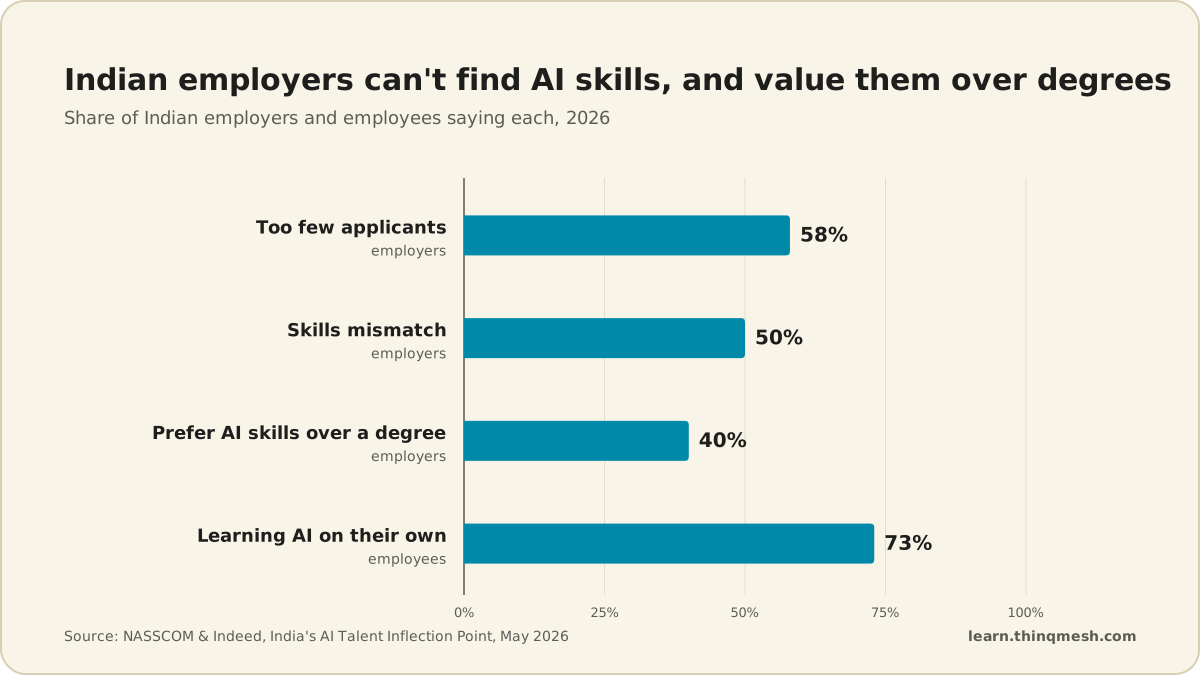
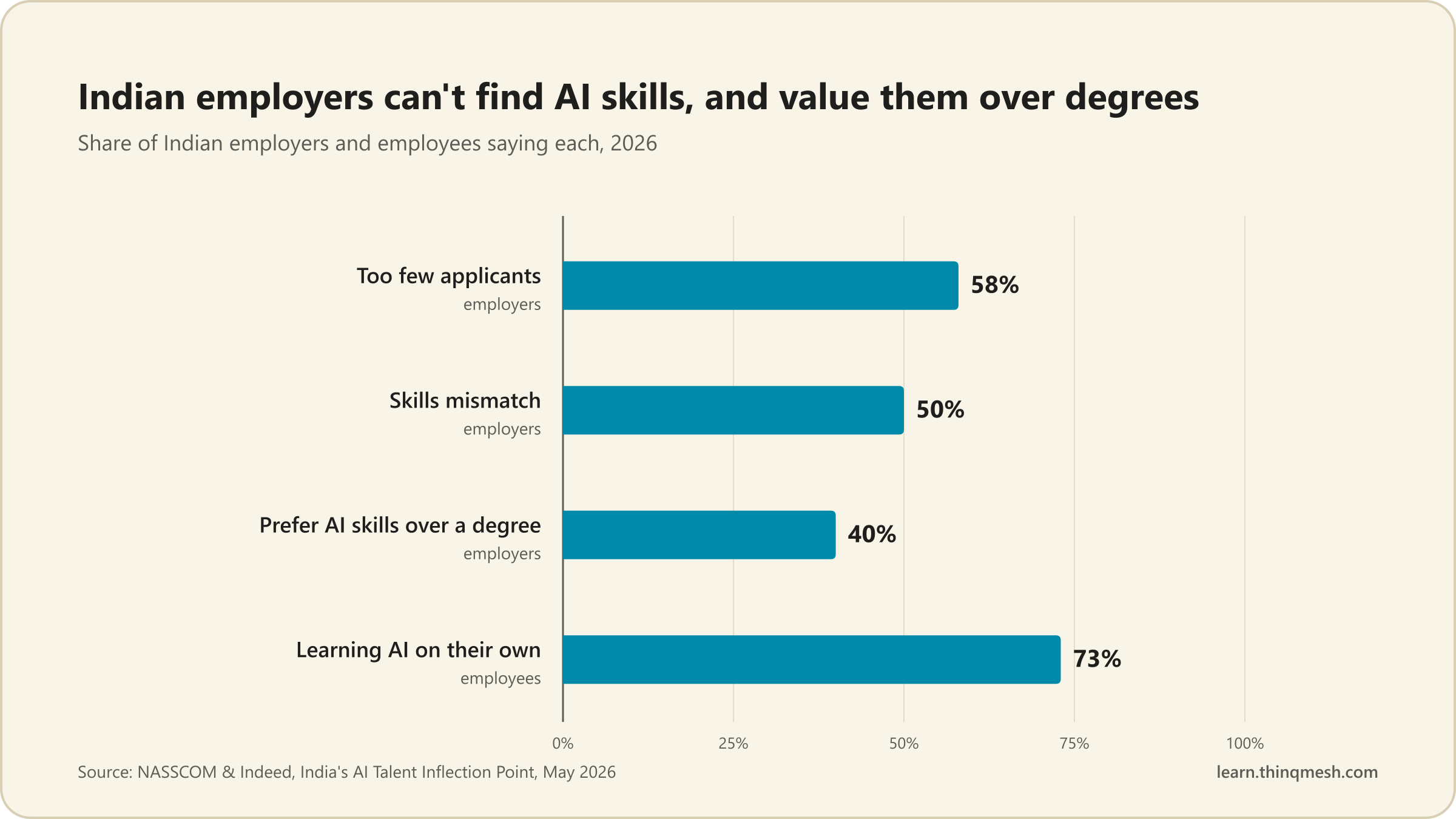
When the usual pipeline does not deliver, employers look for other evidence that someone can do the work. On the employee side, 73% are learning AI through self-driven channels. Plenty of people are learning. The question employers ask is whether they can see the result.
The global picture is the same
Microsoft and LinkedIn's 2024 Work Trend Index found 66% of leaders would not hire someone without AI skills. 71% said they would rather hire a less experienced candidate with AI skills than a more experienced candidate without them (Work Trend Index, 2024).
The same report shows a catch. 78% of the knowledge workers using AI brought their own tools to work, and only 39% had received AI training from their employer. Only 25% of companies planned to offer generative AI training that year. Many employers want AI skill, but they are not always the ones providing it. Candidates who arrive already skilled have the advantage.
A year later, 78% of leaders were considering hiring for AI-specific roles, and 47% listed upskilling existing employees as a top workforce strategy (Work Trend Index, 2025). The World Economic Forum reports that two-thirds of employers plan to hire talent with specific AI skills (WEF, 2025).
Why experience alone is not enough any more
PwC found that the most AI-exposed junior roles are seven times more likely to ask for skills traditionally expected of senior staff (PwC, 2026). A junior who can use AI well can take on work that used to need years of experience.
That cuts both ways. A fresher with real AI skill can compete with people who have been in the job longer. And someone with years of experience who has not picked up AI may find that experience counts for less than it did. AI literacy topped LinkedIn's 2025 Skills on the Rise list (CNBC, 2026).
What "demonstrable AI skills" looks like
A line on your CV saying "proficient in AI tools" proves nothing. Nearly everyone can type a question into an AI assistant. Microsoft and LinkedIn found 75% of knowledge workers already used AI in 2024 (Work Trend Index, 2024). Using it is not the differentiator.
What stands out is a small portfolio of real projects. As an illustration, a strong one might include:
- A workflow you improved. For example, a weekly sales report that took three hours and now takes forty minutes, with notes on which steps AI does and which you still check.
- Something that runs. A simple agent or automation that handles a real task, such as sorting enquiries or drafting first replies for review.
- Evidence of judgement. A case where AI got something wrong, how you caught it, and what you changed.
- A short write-up of each. The problem, what you tried, the result, and what you would do differently.
Judgement matters most. In Microsoft's 2026 Work Trend Index, workers ranked quality control of AI output (50%) and critical thinking (46%) as the most important human skills (Microsoft, 2026). A portfolio that shows you check AI's work says more than one that only shows output.
1.Pick a real task
From your job or studies, not a toy example.
2.Improve it with AI
Note which steps AI does and which you check.
3.Catch what it got wrong
Show how you checked the result.
4.Write it up
The problem, what you did, the outcome.
Certificates versus projects
The NASSCOM and Indeed study mentions certifications alongside skills. A certificate can get you past a filter. A project gets you through the interview, because you can explain every decision in it. An interviewer can ask why you chose one approach over another, what went wrong, and how you would scale it. Those questions are hard to answer from a course you only watched, and easy to answer from work you actually did.
Deloitte and NASSCOM found 60% of Indian workers, and 71% of Gen Z, believe AI skills improve their career prospects (Deloitte & NASSCOM, 2024). If most candidates believe it, belief alone will not set you apart. Finished work will.
What to do next
- Choose one real task from your job or studies that you could improve with AI, and do it properly this month.
- Write it up in half a page: the problem, what you did, how you checked the result, the outcome.
- Add a second project next month that goes a step further, such as a simple automation or agent.
- Update your CV and LinkedIn profile to describe the projects, not the tools.
- Practise explaining one project out loud in two minutes. That is your interview answer.
Each month of AI Fluency ends with a project you keep, built live with a small cohort, so you finish with work you can show. See the programme.