
25 Sept 2026AI Skills Gap
India's AI skills gap: 2.3 million AI jobs, 1.2 million people
India could have more than 2.3 million AI job openings by 2027 and about 1.2 million people to fill them. What the gap is, and why it will not close by itself.
Author: Team Thinqmesh · 5 min read
- inLinkedIn
- Python
- Google Sheets
- ChatGPT
- Claude
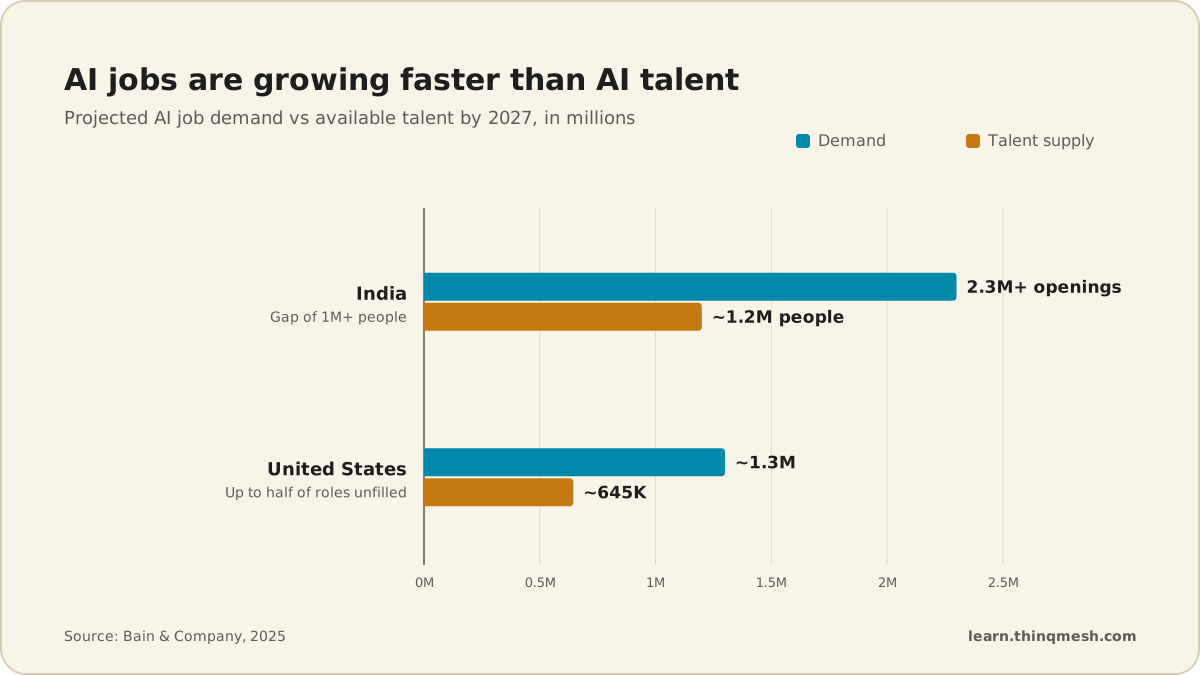
India could surpass 2.3 million AI job openings by 2027. Its AI talent pool is about 1.2 million people (Bain, 2025). That is roughly two openings for every qualified person, and Bain says more than a million people will need reskilling to close it.
This post walks through what the major studies say, where they agree, and what the gap means for someone deciding whether to learn AI now.
The headline number
Bain's estimate is the one most often quoted, and it is worth reading closely. It covers AI job openings in India by 2027, set against a talent pool of about 1.2 million. The US has the same problem at a smaller scale: about 1.3 million openings against about 645,000 people, which means up to half of AI roles there could go unfilled (Bain, 2025).
Bain also found AI job postings have grown 21% a year since 2019, and 44% of executives cite a lack of in-house expertise as a barrier. The demand is not a spike. It has been compounding for years.
Other studies point the same way
Deloitte and NASSCOM projected Indian AI talent demand growing from 600,000–650,000 to more than 1,250,000 between 2022 and 2027 (Deloitte & NASSCOM, 2024). The methods differ from Bain's, but the direction is the same. Demand is roughly doubling in five years.
EY India asked executives directly. 97% named a lack of talent as a primary hurdle to AI, and only 3% said they had enough people in-house. EY also estimates AI could transform 38 million Indian jobs by 2030 (EY India, 2025). ServiceNow, in its own report, expects agentic AI to redefine 10.35 million Indian roles by 2030 (ServiceNow, 2025).
The same ServiceNow report found 26% of organisations are unclear about the skillsets they will need. Employers know the change is coming, but many cannot yet say exactly what to hire for. That uncertainty is one more reason people with broad, practical AI skill are in demand.
Hiring data confirms it. LinkedIn reports AI talent hiring in India up 59.5% year on year, with Hyderabad up 51% (Business Standard, 2026). Stanford's AI Index finds India's share of AI talent grew 120% from 2019 to 2025, among the fastest anywhere (Stanford AI Index, 2026). India is producing AI talent quickly. It is still not producing enough.
What employers are seeing
The 2026 NASSCOM and Indeed study gives the view from the hiring desk. 58% of Indian employers say they get too few applicants, and 50% report a skills mismatch (NASSCOM & Indeed, 2026).
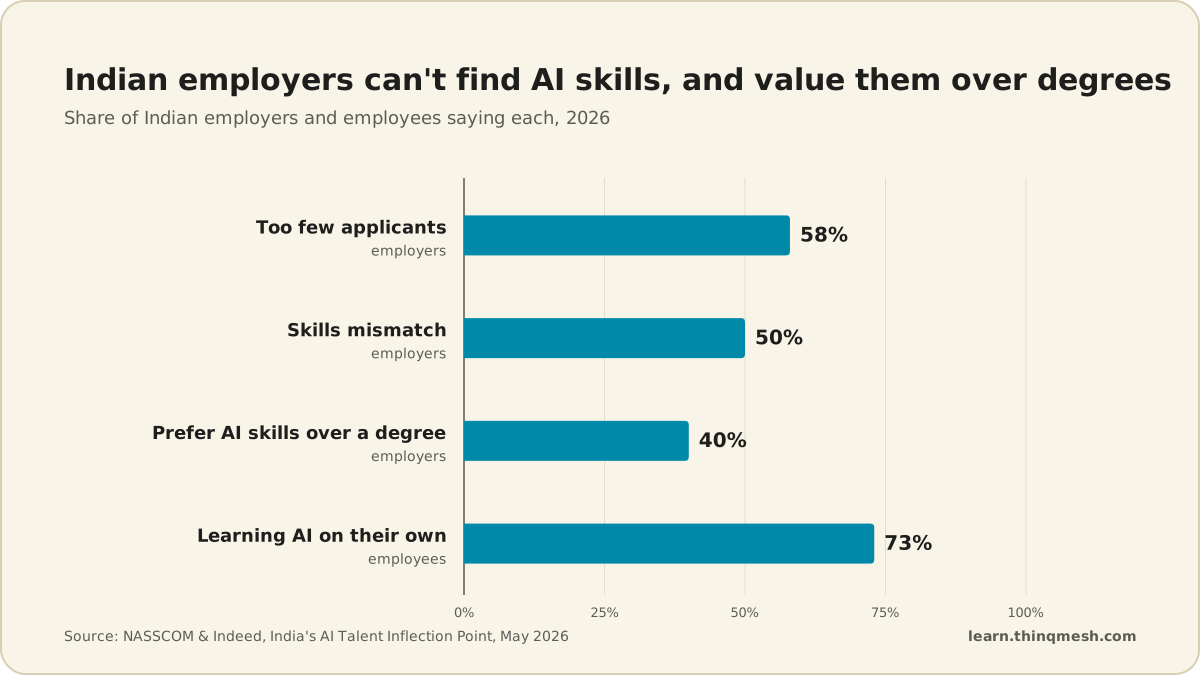
Two more numbers from the same study matter. 40% of employers prefer demonstrable AI skills or certifications over a degree. And 73% of employees are learning AI through self-driven channels. People are trying. Most are doing it alone, without structure or feedback. Among Indeed's markets, only Singapore has a higher share of AI job postings than India.
IT is growing revenue faster than headcount
The IT industry shows how the gap plays out in practice. NASSCOM estimates FY26 revenue at $315 billion, up 6.1%, while headcount grew only 2.3% (YourStory, 2026). The industry is doing more with fewer new hires.
The same report says over two million professionals have been upskilled in AI. Only 200,000–300,000 of them have advanced AI skills. That is the shape of the gap: many people with a basic introduction, far fewer who can apply AI to real work with confidence.
Government skilling helps, but the scale is different
The government is investing. MeitY reports more than 16.29 lakh candidates enrolled or trained through FutureSkills PRIME, and notes that India leads the world in AI talent acquisition, with an annual hiring rate of about 33% (PIB, Dec 2025). NITI Aayog sees an opportunity to create up to 4 million new jobs in five years, and recommends making AI literacy a foundational skill (PIB, Oct 2025).
These are real numbers, but compare the units. Government programmes count in lakhs. The jobs being reshaped count in millions and tens of millions. Public skilling alone cannot close a gap of that size, and it was never meant to.
What the gap means for you
A gap between demand and supply is an opportunity for anyone on the supply side. Deloitte and NASSCOM found 60% of Indian workers, and 71% of Gen Z, already believe AI skills improve their career prospects (Deloitte & NASSCOM, 2024).
Believing it is the easy part. The IT figures show the difference between a basic introduction and skill you can use at work. Closing that difference takes practice on real tasks, with someone checking your work.
1.A basic introduction
Where many upskilled people stop.
2.Practise on real tasks
Do one weekly task with AI, and keep notes.
3.Get your work checked
Learn to check AI output, not just prompt it.
4.Show finished work
Keep a piece an employer can see.
What to do next
- Look at job postings in your own field this week and note how many mention AI. It tells you where your market is going.
- Pick one weekly task and do it with AI for a month. Keep notes on what worked and what you had to correct.
- Go past the introduction. Learn how to check AI output, not just how to prompt it.
- Keep one finished piece of work that shows AI skill, so you have something to show an employer.
Thinqmesh Academy's AI Fluency programme is taught live in small cohorts, with a project you keep at the end of each month. See how it works.