
19 Sept 2026AI Careers
You don't need to work in tech to need AI skills
More than half of job postings asking for AI skills are outside IT. Marketing, HR, finance, teaching and healthcare roles are all asking for them now.
Author: Team Thinqmesh · 5 min read
- inLinkedIn
- Notion
- Google Sheets
- Canva
- ChatGPT
- Claude
51% of job postings that ask for AI skills are outside IT and computer science, according to Lightcast's analysis of job postings (Lightcast, 2025). If you have been assuming AI is a skill for engineers, the job market disagrees.
Lightcast also found generative AI roles in non-tech industries grew 800% since 2022. The people being asked for AI skills now include marketers, recruiters, accountants, teachers and nurses.
Which functions are asking
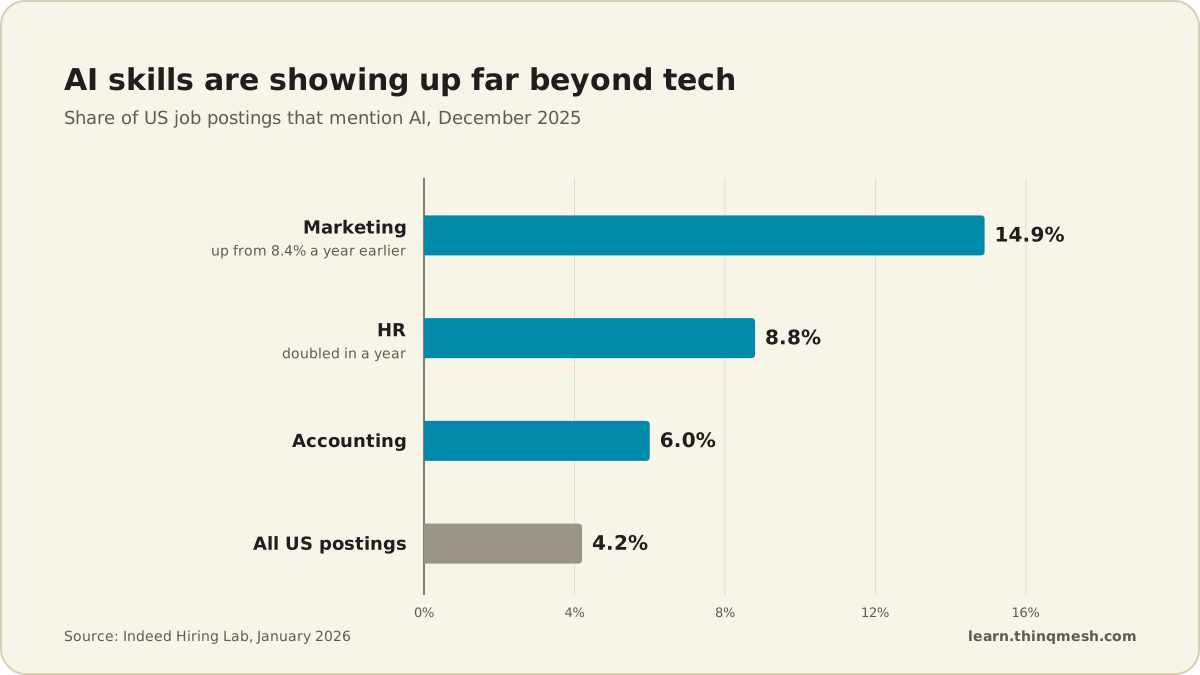
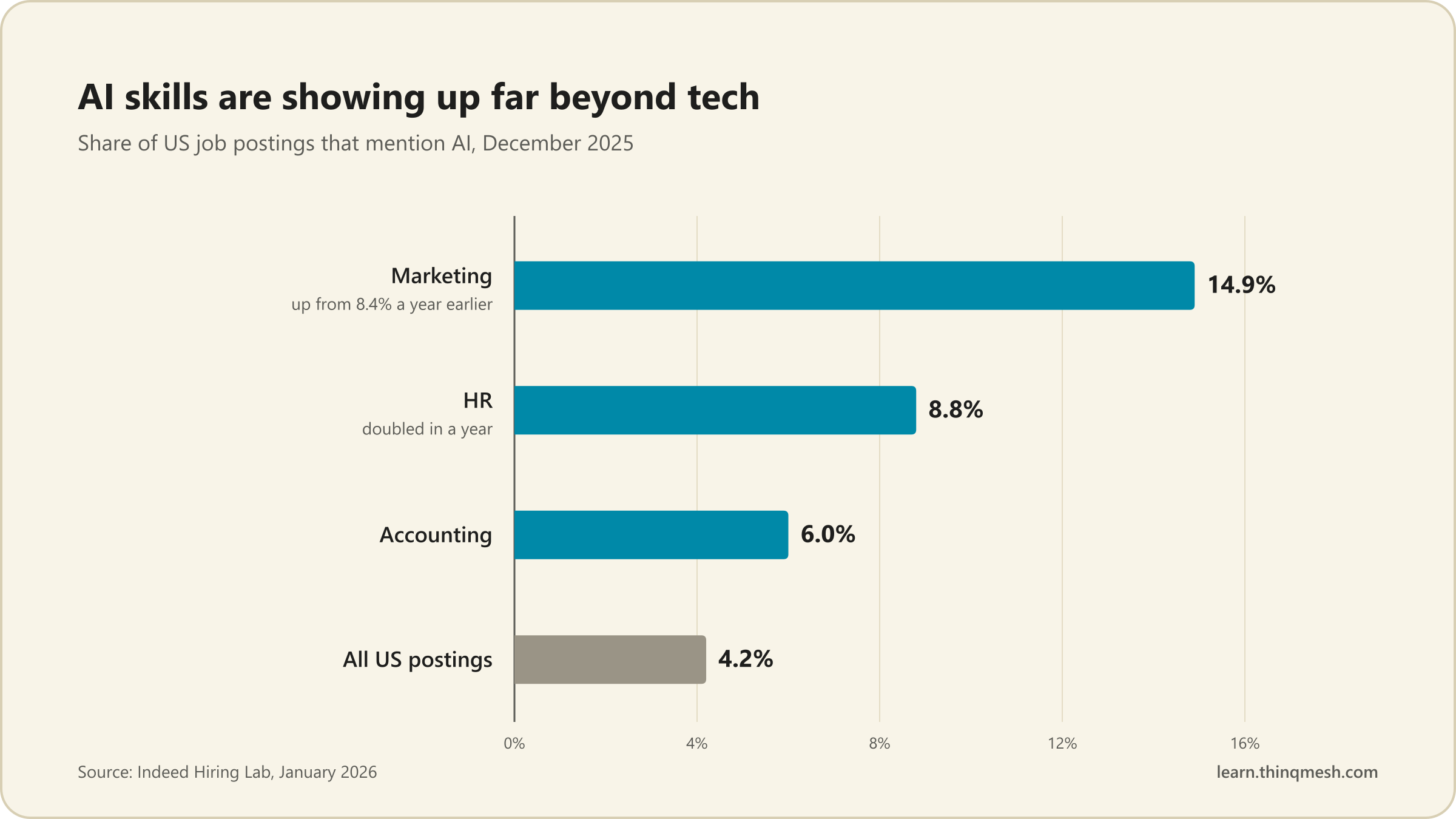
Indeed's US data breaks it down by function. In December 2025, 4.2% of all US job postings mentioned AI. Marketing postings were far above that, at 14.9%, up from 8.4%. HR postings doubled to 8.8%, and accounting reached 6% (Indeed Hiring Lab, 2026).
The same report shows the contrast clearly. Overall US postings are only about 6% above pre-pandemic levels. Postings that mention AI are 134% above. Hiring in general is slow, and hiring for AI skill is not.
These are US figures, but India is not behind. Among Indeed's markets, only Singapore has a higher share of AI postings than India (NASSCOM & Indeed, 2026).
Jobs are changing, not just disappearing
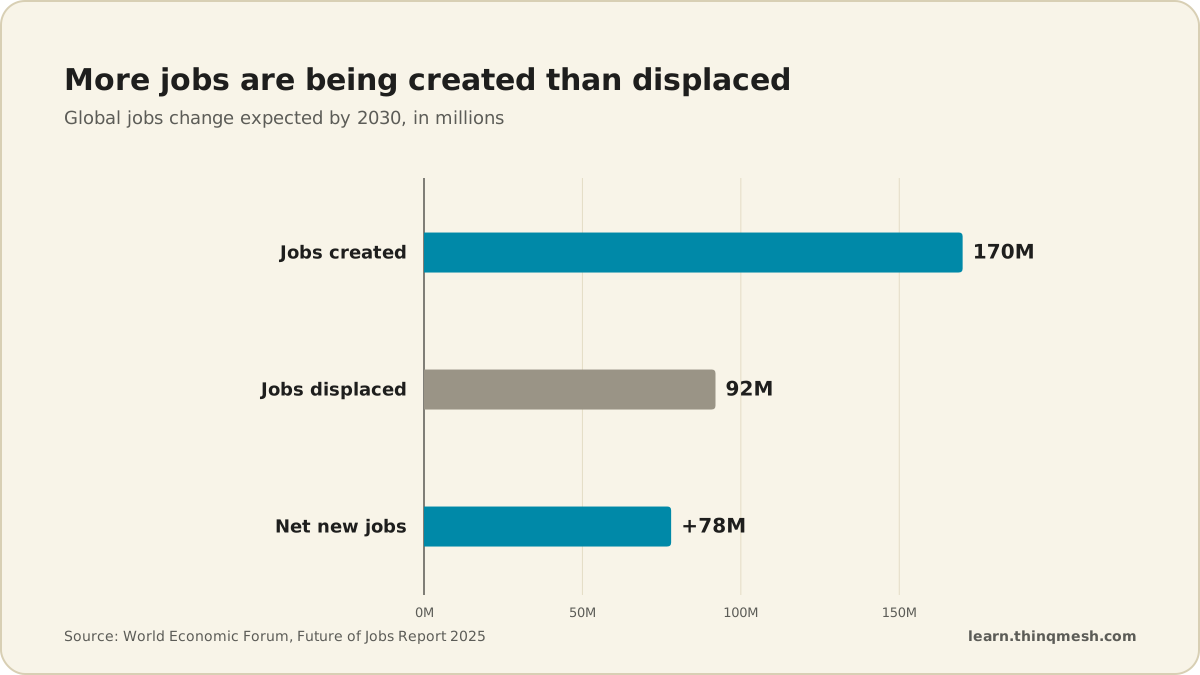
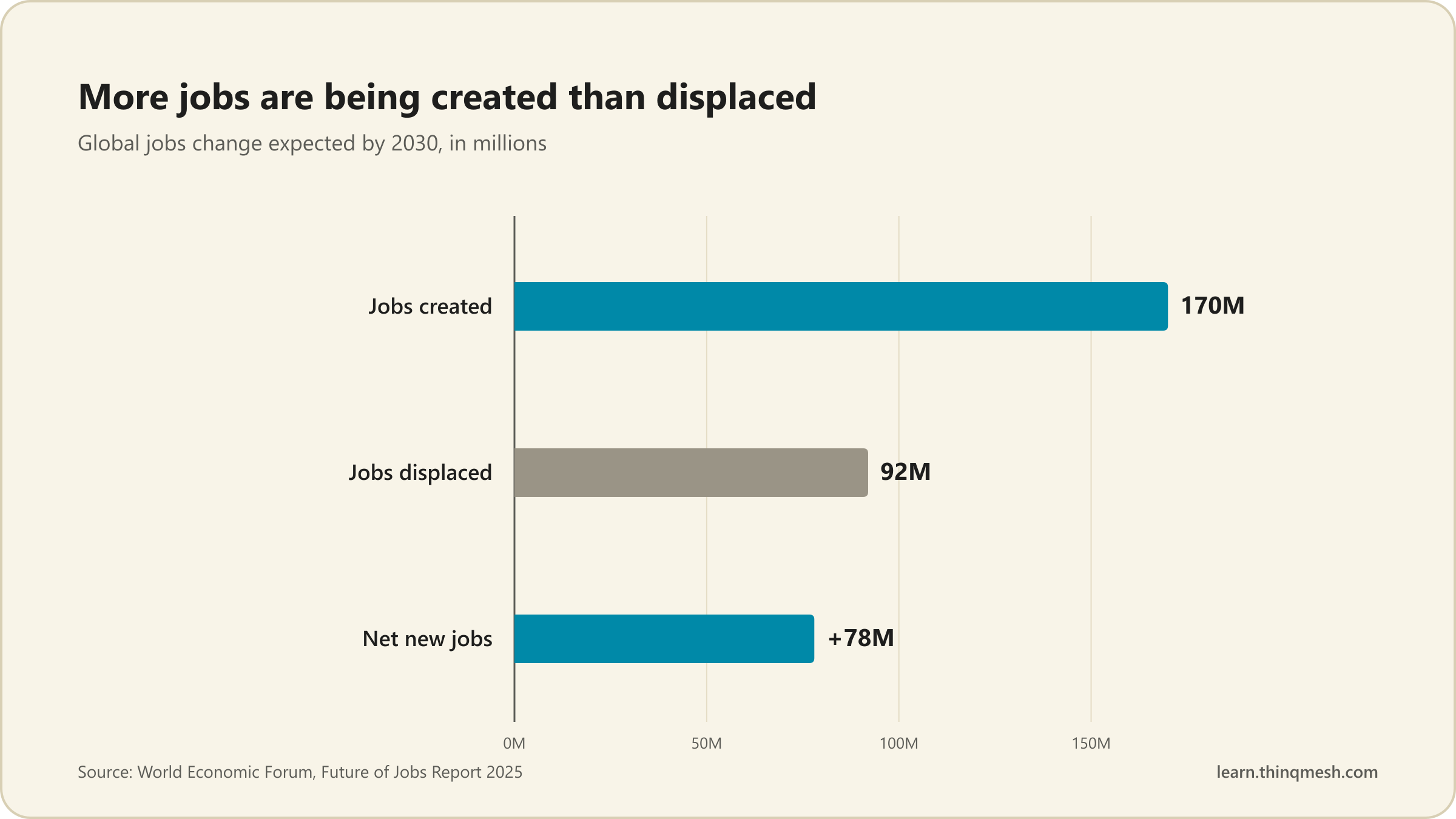
The World Economic Forum expects 170 million jobs to be created and 92 million displaced by 2030, a net gain of 78 million (WEF, 2025). Among the fastest-declining roles are bank tellers and data entry clerks: jobs built around routine tasks that AI now handles.
AI and information processing alone are expected to create 11 million jobs and displace 9 million. The roles most at risk are the ones where a person mainly moves information from one place to another. The roles that grow are the ones where a person uses information to decide, persuade, teach or care for someone.
The WEF also says 59 of every 100 workers will need training by 2030. That is most of the workforce, in every sector. The IMF estimates almost 40% of global employment is exposed to AI, and says workers who can harness it see productivity and wage gains, while those who cannot fall behind (IMF, 2024).
What this looks like in non-tech jobs
Here is how AI shows up across roles and sectors. The examples of daily tasks are illustrations of typical use, not statistics. Each links to a longer post.
Marketing. 86.4% of marketing teams use AI, according to HubSpot (HubSpot, 2026). A marketer might use it to draft campaign variants for different audiences, then edit for brand voice. More in AI for marketers.
Sales. Salesforce reports 87% of sales organisations use AI (Salesforce, 2026). A sales rep might research a prospect before a call in minutes instead of an hour. See AI for sales.
HR and recruiting. SHRM found 39% of organisations have AI in HR (SHRM, 2026). A recruiter might use it to write clearer job descriptions or summarise interview notes. See AI for HR and recruiters.
Finance and accounting. KPMG found active AI use in finance rose from 30% in 2024 to 75% in 2026 (KPMG, 2026). An accountant might use it to flag unusual entries for review. See AI for finance and accounting.
Healthcare. Apollo Hospitals aims "to free up two to three hours of time daily for doctors and nurses" with AI (Business Standard, 2025). See AI in healthcare.
Teaching. From the 2026–27 session, AI and computational thinking will be taught in Indian schools from Grade 3, and the government says "Education in AI should be treated as a basic universal skill" (PIB, Oct 2025). A teacher might use AI to plan lessons at different levels for one class. See AI for teachers.
Agriculture. The government's Kisan e-Mitra chatbot has answered more than 93 lakh farmer queries, in 11 languages (PIB, Feb 2026). See AI in agriculture.
Other posts cover banking and insurance, retail, legal, creators and designers and small business.
Where the business value shows up
McKinsey's 2026 State of AI survey found revenue gains from AI are most often attributed to marketing and sales (McKinsey, 2026). Those are not technical functions. The value from AI is showing up where people deal with customers, content and decisions.
The same survey found 80% of respondents say AI improved their individual productivity, but only 6% of organisations count as AI high performers. The tools are spreading faster than the skill to use them well.
That is also why the skill is not about code. It is about knowing your own work well enough to see which parts AI can help with, and checking what it gives back.
1.Know your own work
List the tasks that take most of your week.
2.Spot where AI helps
Writing, summarising, researching, sorting.
3.Try one task
Use an AI assistant on it this week.
4.Check what it gives back
Line by line, before you rely on it.
What to do next
- List the five tasks that take most of your week. Mark the ones that involve writing, summarising, researching or sorting information. Those are where AI helps first.
- Try one of them with an AI assistant this week, and check the result line by line.
- Read the post for your role or industry above, and pick one idea to try.
- Search job postings in your field for "AI" and see what employers are asking for.
AI Fluency is built for people in every field, not only engineers. It is taught live in small cohorts, with a project you keep each month. See the programme or get started.