
15 Sept 2026AI by Industry
Your next customer might ask out loud: AI skills for India's retail
Indian retail expects 35–37% productivity gains from generative AI in five years. The skills store staff, sellers and category teams need now.
Author: Team Thinqmesh · 5 min read
- Shopify
- WooCommerce
- Canva
- Google Analytics
- ChatGPT
Meesho's voice AI shopping assistant crossed 1.5 million users in its first month, and users who engaged with it converted 22% more often (Business Standard, 2026). It is aimed at India's next 500 million internet users. Many of them will not type a search. They will ask.
That changes what retail work looks like, from the category manager in Bengaluru to the seller in Surat. This post covers the numbers, the roles, the skills and the risks.
What is happening in Indian retail and e-commerce
EY India found that 48% of retail, consumer and e-commerce companies have started generative-AI proofs of concept (EY India, 2025). EY expects productivity gains of 35–37% in the next five years, rising to 40–45% in pricing, promotions and customer experience, and 38–40% in the supply chain.
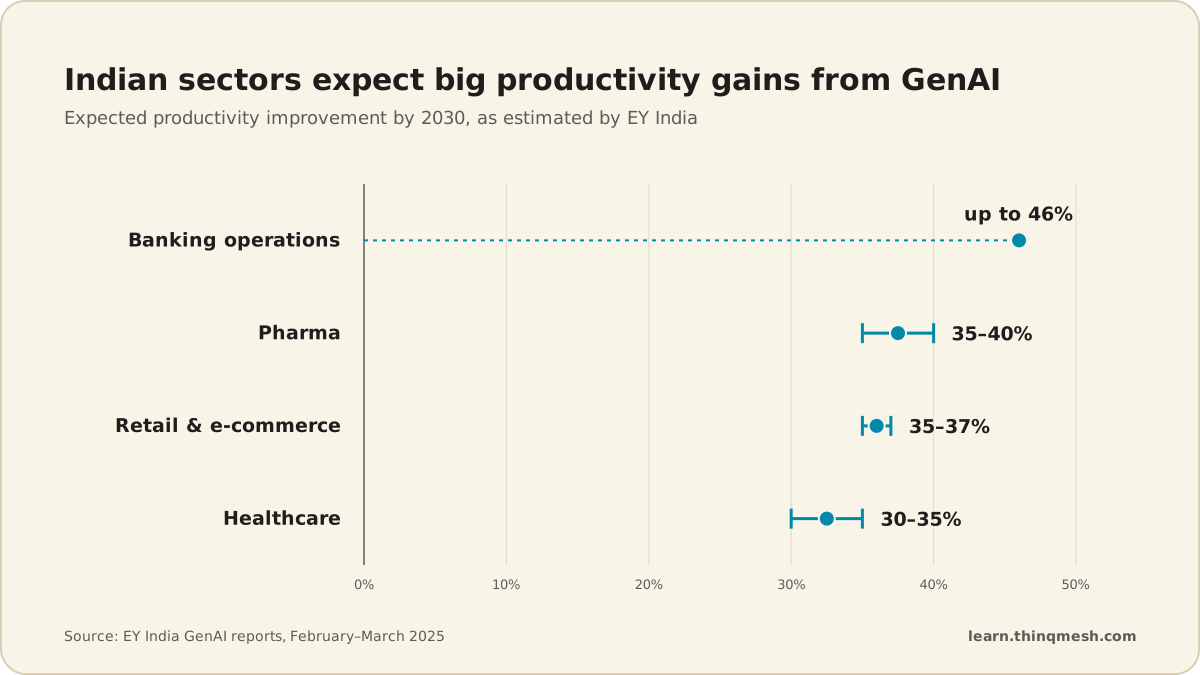
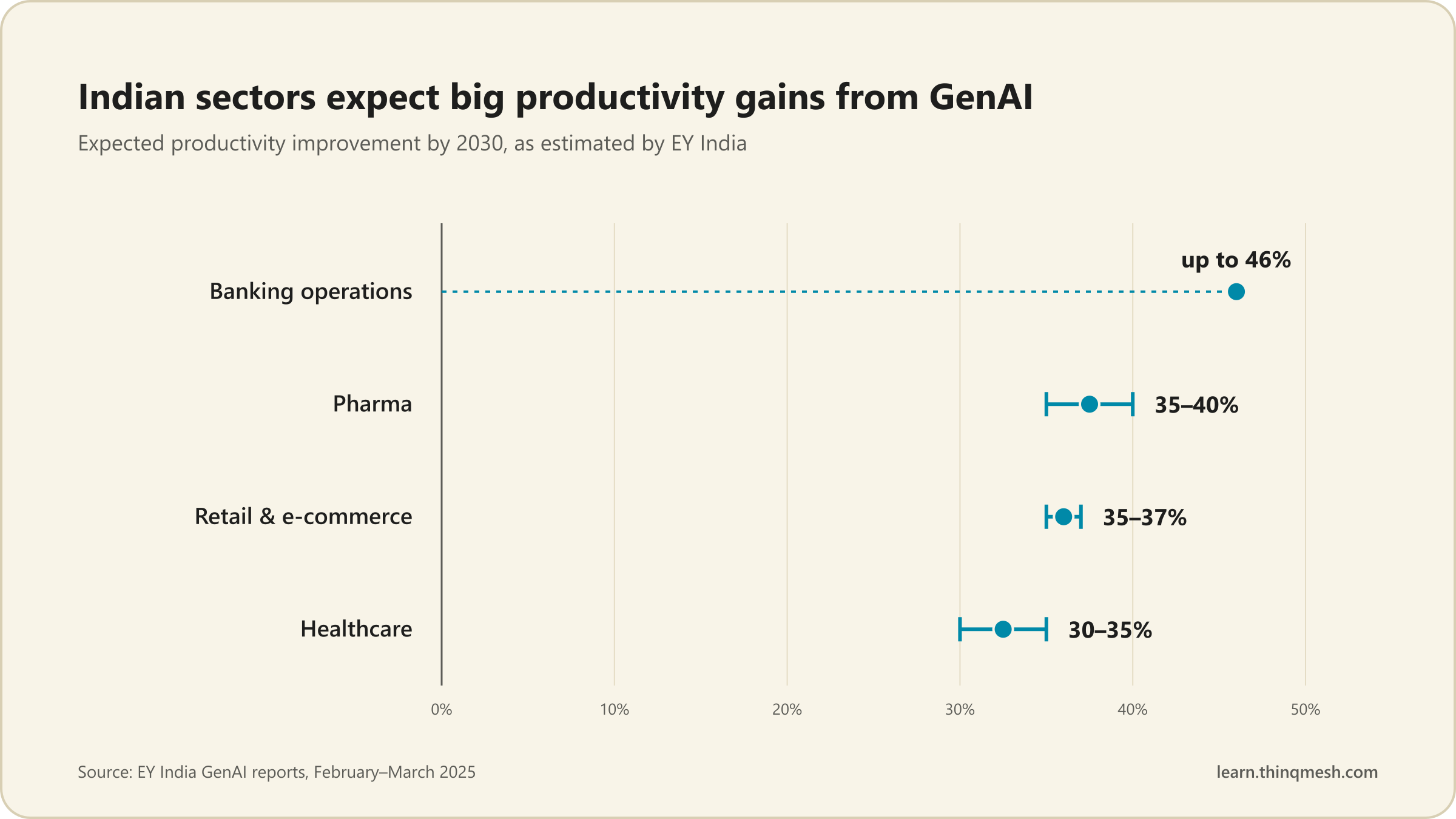
The early results are already on the books. In the same EY survey, 56% of companies reported cost reduction and 44% reported higher revenue.
Shoppers are changing too. In the US, traffic to retail sites from generative-AI platforms rose 693% year on year over the 2025 holiday season, and those shoppers converted 31% more, according to Adobe data (Digital Commerce 360, 2026). India is not the US, but the direction is the same: more people will arrive at a product having already asked an AI about it.
Behind the counter, AI is running the stockroom. Walmart says its Self-Healing Inventory system has saved more than $55 million (Walmart, 2025). And across all industries, McKinsey finds revenue gains from AI are most often attributed to marketing and sales (McKinsey, 2026).
Which roles gain, and how
The examples below are illustrations of a working day, not survey findings.
Store staff and store managers. A shopper walks into a Jaipur apparel store and asks, in Hindi, for "something like what the actress wore at the wedding". A staff member uses the store's assistant on a tablet to find three matching options in stock, in two sizes. The manager, meanwhile, gets a morning summary of yesterday's sales and which items are running low.
Online sellers. A small seller on a marketplace writes product listings in English, Hindi and Tamil with an assistant, then checks each for accuracy. Wrong fabric or wrong size claims mean returns, so the checking is the real work.
1.Draft the listing
In English, Hindi and Tamil, with an assistant.
2.Check every claim
Fabric and size must match the actual product.
3.Publish
Only once each fact has been checked.
Category and pricing teams. A category manager asks an assistant to compare this festive season's discount performance with last year's, by region. She spots that one promotion drove returns, not sales. EY's highest expected gains are here, in pricing and promotions.
Customer service teams. A voice assistant handles "where is my order" at midnight. The human agent handles the customer whose wedding outfit arrived torn. The second call is harder, and it is the one that keeps the customer.
Supply-chain and merchandising planners. Demand forecasts get sharper, but someone still has to know that a local festival is coming, or that a supplier is unreliable. Planners who can question a forecast are worth more than those who just accept it.
Marketing roles feel this first. In the US, 14.9% of marketing job postings now mention AI, up from 8.4% (Indeed Hiring Lab, 2026).
The skills to build
- Writing clear instructions. A good product-description prompt, with your brand's tone and the facts that must never be wrong, can be reused across a thousand listings.
- Checking before publishing. Every AI-written listing, price or promotion needs a human check against the actual product.
- Reading data questions in plain language. You don't need to code. You need to ask a sharp question of your sales data and notice when the answer looks odd.
- Designing for voice and local languages. If customers ask out loud, think about how your products are described when spoken, not only when read.
In India, 50% of employers cite a skills mismatch when hiring, and 40% prefer demonstrable AI skills over a degree (NASSCOM & Indeed, 2026).
The risks, and what still needs humans
AI makes it easy to produce a lot of content quickly, and not all of it is good. US desk workers who received "workslop", AI content that looks good but lacks substance, spent about two hours resolving each instance (BetterUp Labs & Stanford, 2025). A thousand listings with small errors is workslop at scale.
Sameness is another risk. In a BCG study, the diversity of ideas was 41% lower among people using AI (BCG, 2023). If every seller writes with the same tool in the same way, every listing starts to read alike.
What stays human
Knowing your customer, your neighbourhood and your festivals. Handling a complaint with care. Deciding what your brand will and won't say.What to do next
- Pick ten of your product listings or shelf labels and rewrite them with an assistant, checking every fact.
- Try describing your top five products out loud, as a customer would ask for them. Note the words people actually use.
- Ask one sharp question of last month's sales data with an approved AI tool, and verify the answer by hand.
- Agree with your team on what AI may write and what always needs a manager's sign-off.
If you want to learn this with a group, AI Fluency is taught live in small cohorts, with a project you keep each month.