
16 Sept 2026AI by Industry
₹22,000 crore from AI leads: what India's banks expect from bankers
SBI generated about ₹22,000 crore of business from AI leads. Here is what India's banks and insurers now expect from their people.
Author: Team Thinqmesh · 5 min read
- XExcel
- SSalesforce
- BIPower BI
- TTableau
- Zendesk
- OOutlook
- ChatGPT
- Claude
State Bank of India generated about ₹22,000 crore of business through AI-generated analytical leads (Financial Express, 2026). A model found the leads. People still had to call the customers, explain the product and close the loan. That split is the shape of banking work now.
This post covers what is happening across Indian banks and insurers, which roles gain, the skills to build, and what must stay with a human.
What is happening in Indian banking and insurance
Financial services is the most advanced industry in EY India's survey. 74% of financial firms have started generative-AI proofs of concept and 11% have it in production (EY India, 2025). EY expects productivity gains of up to 46% in banking operations by 2030, with cost per unit as low as one-tenth of manual work.
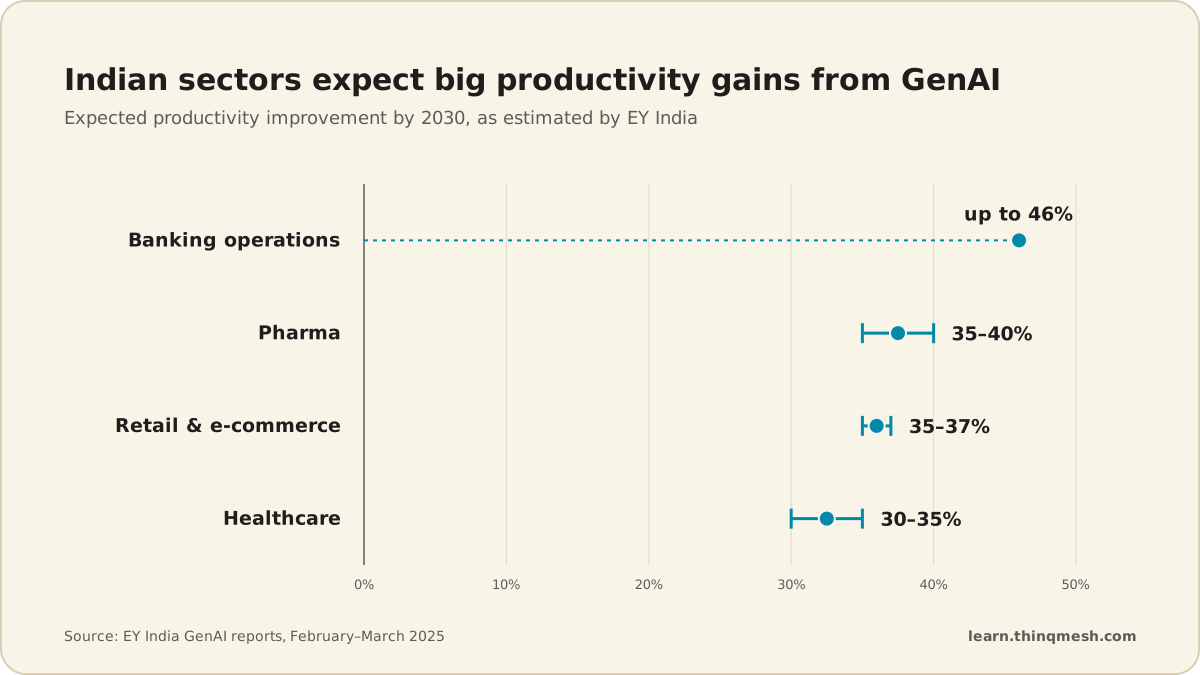
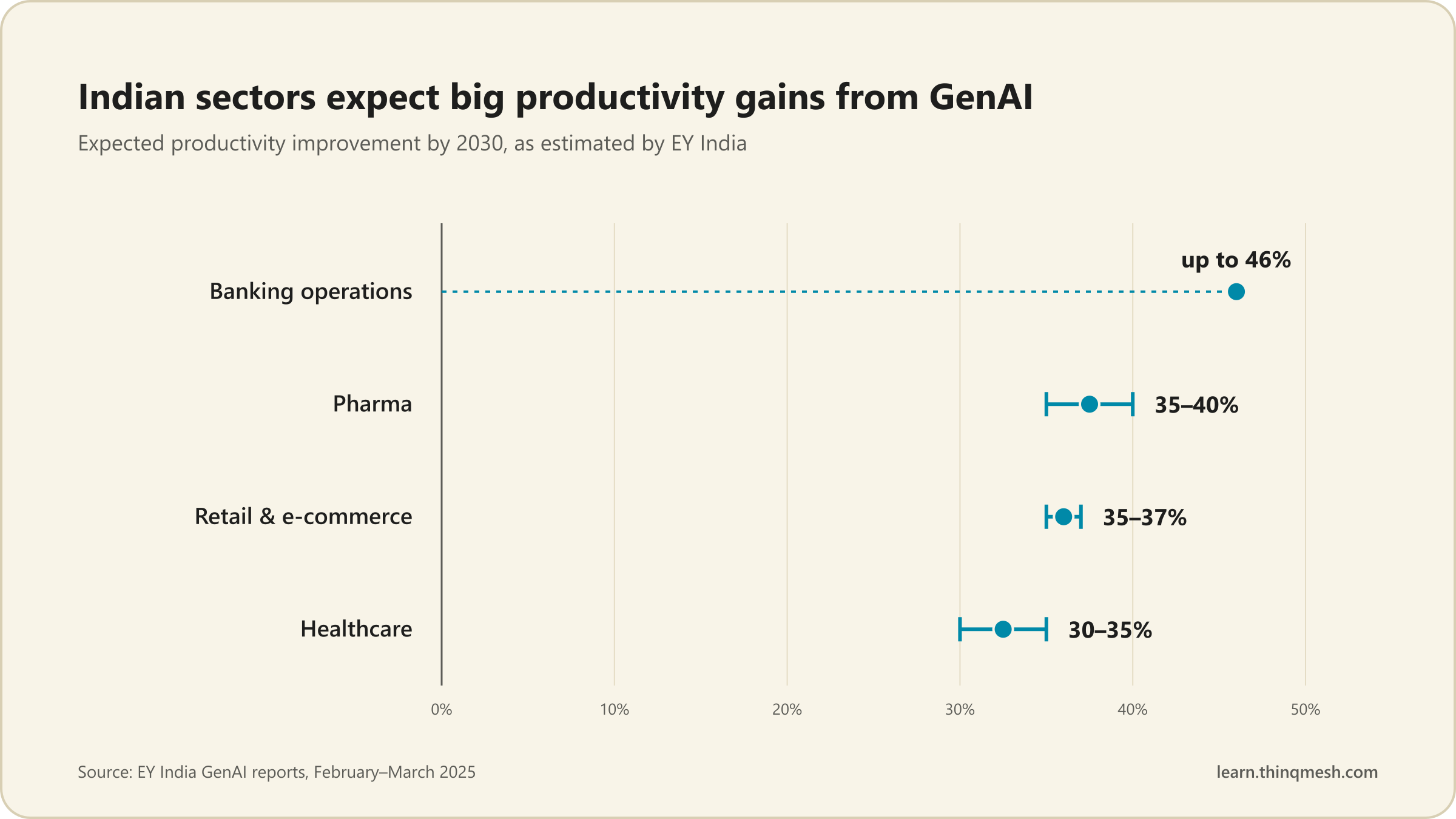
The gains are spread across functions: 38–40% in sales and customer service, 34–36% in credit and collections, and 48% in insurance customer service, per the same EY report.
Banks are already showing results. Besides SBI's leads, HDFC Bank cut the effort of its home-loan eligibility search by about 50%, with 5 AI use cases live and 14 in development (Financial Express, 2026).
The regulator is watching closely. The RBI's FREE-AI committee surveyed regulated entities and found 20.8% deploy AI, mainly in customer support, sales, credit underwriting and cybersecurity, while 67% are exploring at least one generative-AI use case (figures via KPMG's summary of the RBI report, 2025). The framework's name says what it expects: responsible and ethical use.
In insurance, BCG estimates AI can cut claims costs by up to 20%, process claims up to 50% faster and resolve up to 70% of simple claims in real time (BCG, 2025). It also found admin takes over 50% of an agent's or broker's time.
Which roles gain, and how
Globally, bank tellers are among the fastest-declining roles and fintech engineers among the fastest-growing (WEF, 2025). Most bankers sit between those two. The examples below are illustrations of an ordinary day, not survey findings.
Relationship managers. A branch RM opens the morning with a list of customers the bank's model has flagged as likely to need a home loan or a fixed deposit. She uses an assistant to summarise each customer's history in three lines before calling. The model picks who. She decides how, and whether the product actually suits the person.
Credit analysts. A small-business loan file arrives with bank statements, GST returns and a project report. An assistant pulls the key figures into a first-draft credit note. The analyst checks every number against the documents and writes the part that matters: the judgement on whether this borrower can repay.
1.Model flags or drafts
A lead list or a first-draft credit note.
2.Check against documents
Every number traced back to the source.
3.Make the judgement
Does it suit the customer? Can they repay?
4.Explain it plainly
To the customer, the auditor and the regulator.
Collections teams. An agent reviews an AI-drafted, polite reminder in the customer's language, adjusts the tone for a borrower who has just lost a job, and sends it. The empathy is the job.
Insurance claims staff and agents. A claims handler sees simple motor claims settled automatically and spends her day on the complex ones: disputed damage, possible fraud, a family in distress. An agent who used to spend half the week on forms now spends it with clients.
Compliance and risk officers. Someone has to know which models the bank uses, what data they see and how decisions are explained. That work is growing, not shrinking.
The skills to build
- Reading a model's output critically. A lead score or a draft credit note is a starting point. Ask what data it used and what it might have missed.
- Explaining AI-assisted decisions. Customers and auditors will ask why. You need to answer in plain words.
- Protecting customer data. Knowing which tools are approved, and what must never be pasted into a public AI assistant, is basic hygiene now.
- Writing clear instructions. A good prompt for summarising a loan file is a reusable asset for a whole branch.
Employers already look for this. In India, 40% of employers prefer demonstrable AI skills or certifications over a degree (NASSCOM & Indeed, 2026).
The risks, and what still needs humans
Unchecked AI output costs real money. Deloitte Australia refunded over A$97,000 on a A$440,000 government report that contained a fabricated court quote and non-existent papers (CFO Dive, 2025). A credit note with an invented figure is the banking version of that story.
The habit is widespread. 66% of employees rely on AI output without evaluating it (KPMG & University of Melbourne, 2025). And people who feel more confident in generative AI tend to think less critically about its output (Microsoft Research & CMU, 2025).
What stays human
The lending decision, the conversation with a customer in trouble, the fraud call that doesn't fit the pattern, and accountability to the regulator.What to do next
- Find out which AI tools your bank or insurer has approved, and what data you may use with them.
- Take one repetitive document you prepare, such as a call summary or a claim note, and try drafting it with an approved assistant for two weeks.
- Check every number in every draft against the source. Keep a list of what the tool got wrong.
- Practise explaining one AI-assisted recommendation to a colleague in three plain sentences.
- Read the RBI's FREE-AI principles once, so you know what "responsible use" means in your sector.
If you want to build these habits with others, AI Fluency is taught live in small cohorts, with a project you keep each month.