
17 Sept 2026AI by Industry
Two to three hours back each day for India's doctors and nurses
India's hospitals expect 30–35% productivity gains from generative AI by 2030. Here is what that means for doctors, nurses and hospital staff.
Author: Team Thinqmesh · 5 min read
- Google Docs
- Google Sheets
- Google Meet
- ChatGPT
- Claude
- Gemini
Apollo Hospitals wants AI to free up two to three hours a day for its doctors and nurses (Reuters via Business Standard, 2025). That is not a promise of fewer staff. It is a bet that paperwork, not patients, is eating the working day, and that the hours can be handed back.
This post looks at what is actually happening in Indian healthcare, which roles gain and how, and the skills that make the difference between AI that helps and AI that creates new work.
What is happening in Indian healthcare
The shift has moved past talk. EY India found that 66% of healthcare organisations and 50% of pharma companies have started generative-AI proofs of concept, and 25% of pharma firms already have it in production (EY India, 2025). EY expects efficiency gains of 30–35% in healthcare and 35–40% in pharma by 2030.
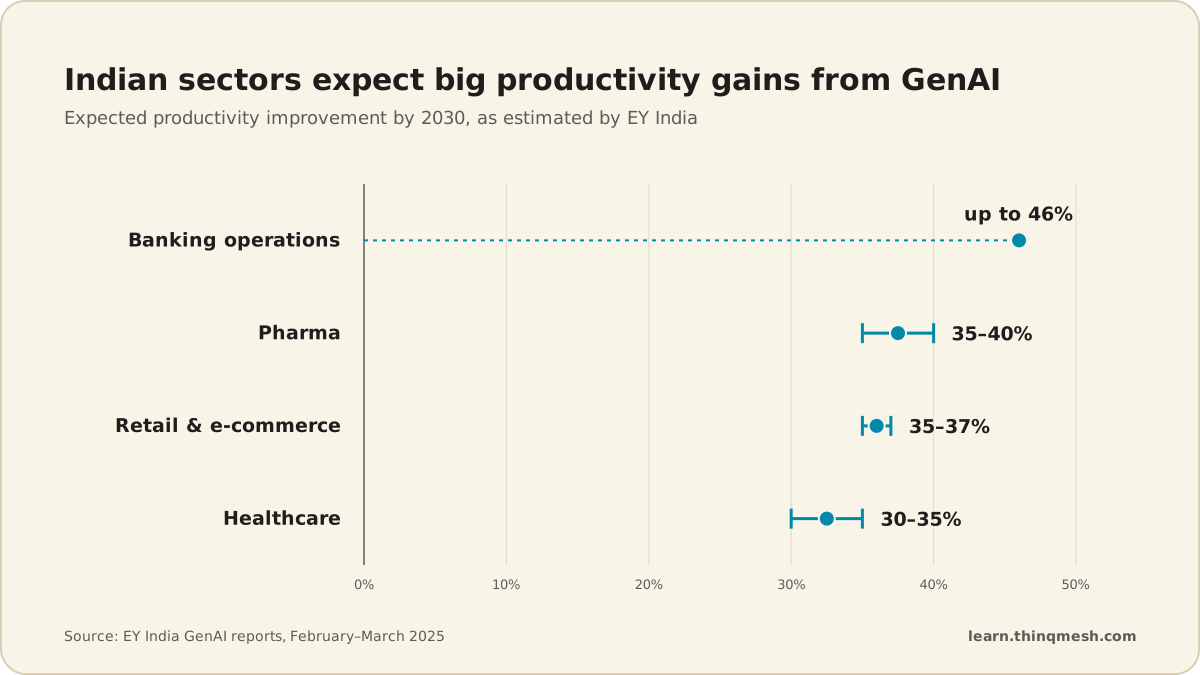
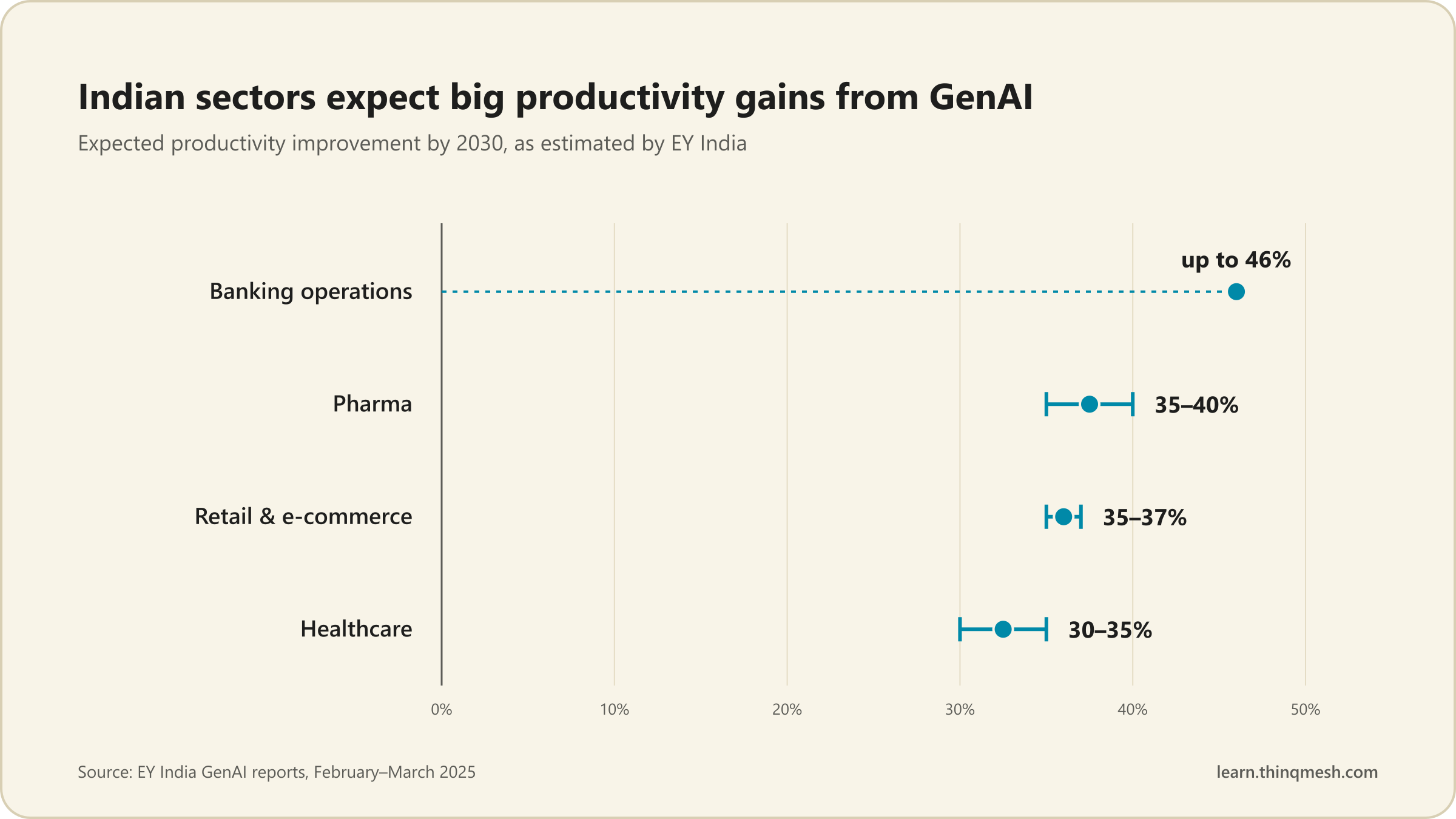
Where do those gains come from? EY names two early uses: medical documentation assistants and revenue cycle management. Both are about the work around care, not care itself.
The pressure is real. At Apollo, nurse attrition is 25% and expected to reach 30%, and the group has set aside 3.5% of its digital spend for AI (Reuters via Business Standard, 2025). When experienced nurses leave, every hour of documentation lands on fewer people.
Public health is moving too. India's AI for TB initiative increased early detection by 16%, and more than 70% of the AI approvals from the US regulator, the FDA, are in imaging (WEF & BCG, 2025). The same report expects the AI-in-healthcare market to reach $491 billion by 2032.
Which roles gain, and how
The examples below are illustrations of a normal working day, not survey findings. They show where the hours EY and Apollo talk about could come from.
Nurses. A ward nurse ends a twelve-hour shift and has to write handover notes for eight patients. An AI documentation assistant drafts each note from the day's charted vitals and medication records. The nurse reads every line, corrects what is wrong, adds what only she saw at the bedside, and signs. Twenty minutes becomes a careful five.
1.Draft from the records
Charted vitals and medication, in approved tools.
2.Read every line
Correct what is wrong against the source.
3.Add what only you saw
What happened at the bedside.
4.Sign it off
The clinician signs, not the tool.
Doctors. A resident in a busy OPD dictates a few lines after each consultation. The assistant turns them into a structured note and a draft discharge summary in plain language the family can follow. The doctor still decides the treatment. The tool only removes the typing.
Medical coders and billing teams. Revenue cycle work means matching procedures to codes, chasing missing documents and answering insurer queries. An assistant can flag a claim that is missing a report before it is sent, so it is not rejected three weeks later.
Pharma medical writers and regulatory staff. A first draft of a study summary or a response to a regulator's query can be produced from approved source documents. The writer's job becomes checking every claim against the source, which is slower than it sounds and more valuable than typing.
Hospital administrators. Bed occupancy, discharge delays and staff rosters can be summarised each morning in one page. The administrator spends the hour deciding, not compiling.
The skills to build
None of these roles needs coding. They need a handful of habits that most people never get taught.
- Giving the tool the right context. A discharge summary is only as good as the notes and results it is built from. Knowing what to include, and what must never leave the hospital system, is the first skill.
- Checking output against the source. Microsoft's 2026 survey found workers rank quality control of AI output (50%) and critical thinking (46%) as the most important human skills (Microsoft Work Trend Index, 2026). In a hospital, that check is a patient-safety step.
- Knowing which tasks to hand over. Drafting and summarising, yes. A dosage decision, no.
- Writing clear instructions for a team. When a senior nurse can write a good template prompt for handover notes, the whole ward benefits.
Training matters more than tools. BCG found regular use rises sharply when people get at least five hours of training plus in-person coaching, yet only one-third of workers say they have been properly trained (BCG, 2025). EY reports that 97% of Indian executives cite a lack of talent as a primary hurdle (EY India, 2025).
The risks, and what still needs humans
AI is uneven. In a Harvard and BCG study, consultants were right 84% of the time on a task designed for AI to fail, but only 60–70% of the time when they used AI (HBS AI Institute). A tool that is excellent at summarising notes can still be confidently wrong about a lab value.
Over-trust is the bigger risk. A global study of more than 48,000 people found 66% rely on AI output without evaluating it, and 56% have made mistakes because of AI (KPMG & University of Melbourne, 2025). In medicine, an unchecked error has a name and a bed number.
Privacy is the third. Samsung banned generative-AI tools on company devices after staff pasted internal data into a public AI chatbot, (CSO Online, May 2023). Patient records are far more sensitive than source code.
What stays human
Diagnosis, consent, breaking bad news, and the judgement call at 3 a.m. The goal of AI in a hospital is to give clinicians more time for exactly these things.What to do next
- List the three documents you write most often in a week. Those are your first candidates for an AI draft.
- Ask your IT or quality team which AI tools are approved, and never paste patient details into a public tool.
- Pick one document type and try an approved assistant on it for two weeks, checking every line against the source record.
- Write down every error you catch. That list becomes your team's checking guide.
- Share one good template with a colleague, so the hours saved are not yours alone.
If you want a structured way to build these habits, AI Fluency is taught live in small cohorts, with a project you keep at the end of each month.