
8 Sept 2026AI by Role
AI in HR: 7% saw job losses, 24% saw new roles. Which side are you on?
SHRM found 7% of organisations saw AI displace HR jobs while 24% saw it create new roles. Here is what HR people on the right side are learning.
Author: Team Thinqmesh · 5 min read
- inLinkedIn
- Greenhouse
- WWorkday
- Google Docs
- Gmail
- Calendly
- ChatGPT
- Claude
In SHRM's 2026 survey, 7% of organisations said AI in HR had displaced jobs. More than three times as many, 24%, said it had created new roles, and 57% said it had led to more upskilling (SHRM, 2026). For most HR professionals, AI is changing the job rather than ending it. Which way it goes for you depends on what you learn next.
What the numbers say for HR
SHRM found 39% of organisations now use AI in HR. Recruiting leads at 27%, followed by HR technology at 21% and learning and development at 17%. 87% of organisations reported improved efficiency and 75% better work quality.
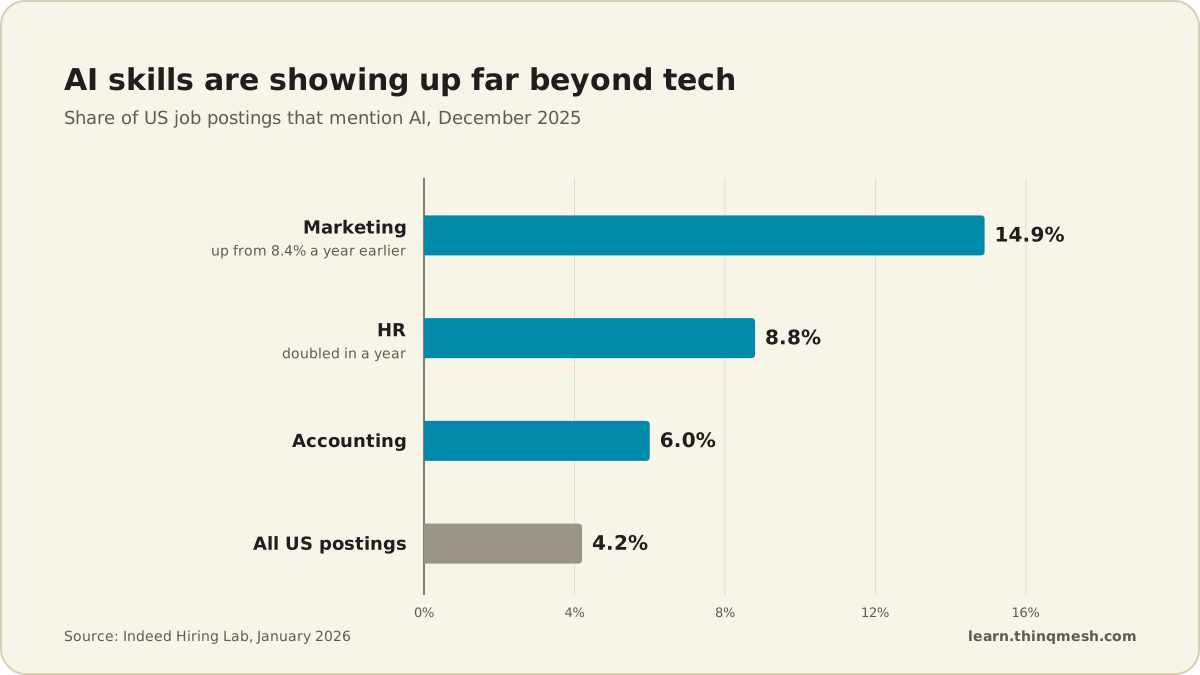
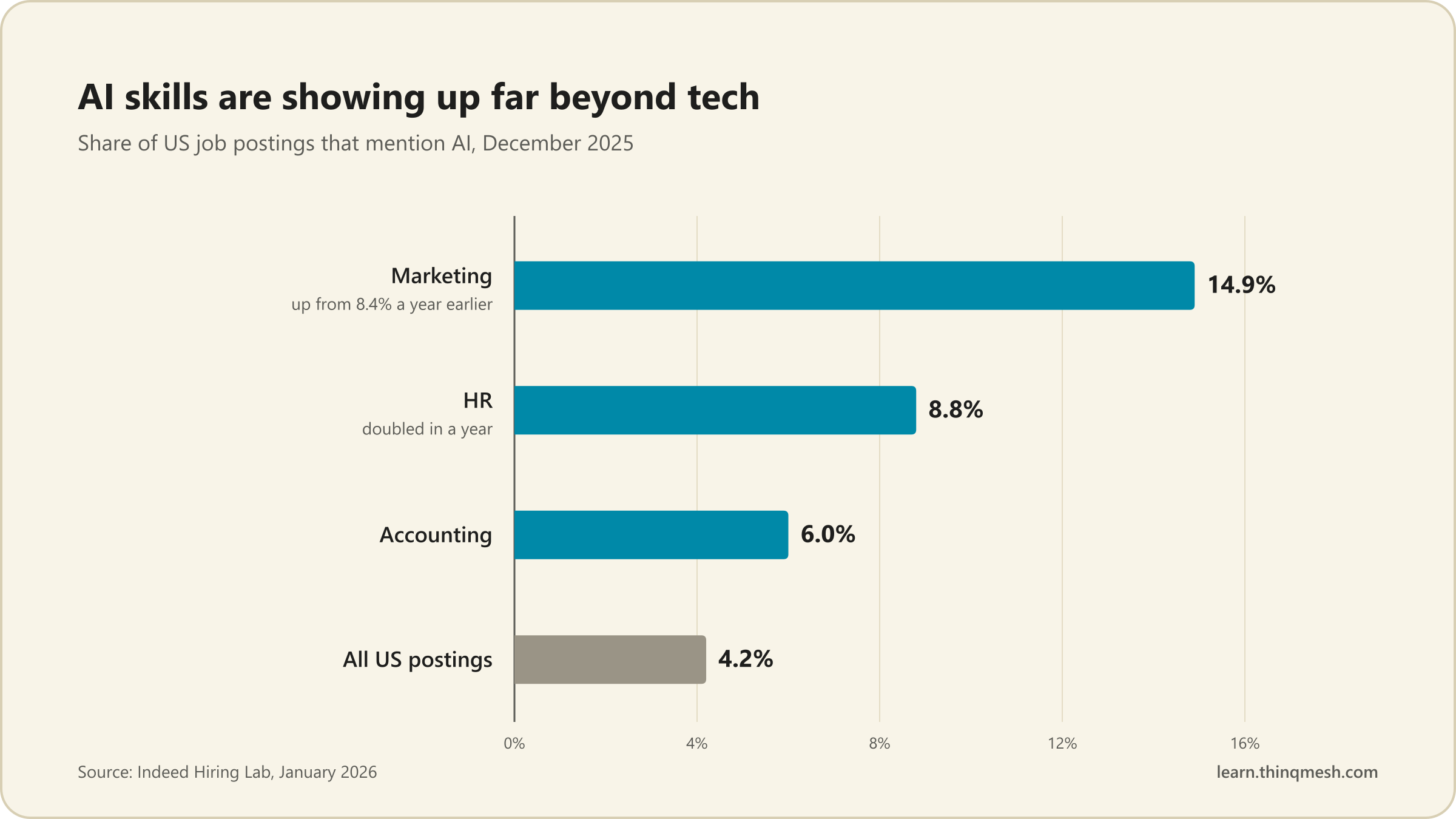
Job ads are moving too. In the US, 8.8% of HR postings mentioned AI in December 2025, double the year before, against 4.2% of all postings (Indeed Hiring Lab, 2026).
HR also sits at the centre of the skills question for everyone else. In India, 58% of employers cite too few applicants and 50% a skills mismatch. 40% prefer demonstrable AI skills or certifications over a degree, and 73% of employees are learning AI on their own (NASSCOM & Indeed, 2026). Someone has to design the hiring and the training that closes that gap. That is HR's job.
What the day-to-day work looks like with AI
The vendors make big claims. LinkedIn says users of its Hiring Assistant review 81% fewer profiles (LinkedIn). That is LinkedIn's own claim about its own product. Wipro's appraisal agent cuts performance review effort by nearly 70%, according to Microsoft (Microsoft, 2026).
On an ordinary working day, it looks more like this. These are illustrations, not survey data.
- A recruiter at a Noida IT services firm asks AI to turn a hiring manager's rambling voice note into a clear job description, then rewrites the requirements so they describe skills, not years of experience.
- An HR business partner in Chennai uses AI to draft structured interview questions for a new role, with a scoring guide for each answer. The panel agrees on the guide before the first interview.
- An L&D manager feeds anonymised feedback from a training programme into an AI assistant and asks it to group the comments into themes. She reads a sample herself to check the themes are fair.
- A policy writer asks AI to draft a plain-language summary of the new leave policy in English and Hindi, then checks every line against the actual policy before it goes out.
1.Write a precise brief
Describe the role, the audience and the tone.
2.AI drafts
Job description, interview guide or policy summary.
3.Check against the source
Every line against the real policy or role.
4.A person owns it
The panel or the owner signs off before it goes out.
The skills to build
Writing precise instructions. Job descriptions, interview guides and policy summaries all start as a brief. The better you describe the role, the audience and the tone, the better the draft.
Auditing AI decisions. When AI screens or ranks candidates, HR must be able to ask why. Learn to test a screening tool with sample profiles and look for patterns: does it favour certain colleges, gaps in employment, or particular phrasing?
Designing AI training for others. Only 39% of AI users in Microsoft and LinkedIn's 2024 research had received company AI training (Work Trend Index, 2024). BCG found regular use rises sharply when people get at least five hours of training plus in-person coaching (BCG, 2025). Microsoft found 35% of managers are considering hiring AI trainers (Work Trend Index, 2025). HR people who can run that training well will be in demand.
Hiring for AI skills. 66% of leaders in the 2024 Microsoft and LinkedIn study said they would not hire someone without AI skills. HR needs to know how to test for them in an interview, not just list them in an ad.
Try this week: take one job description your team published recently. Ask AI to rewrite it for clarity and to remove requirements that are not truly needed. Then ask it which parts might put off good candidates. Compare with the original, and decide yourself which changes to keep.
What stays human, and the risks
HR decisions change people's lives. A hiring, promotion or exit decision must have a person who owns it and can explain it. AI can prepare the file. It should not make the call.
Bias is the biggest risk. AI tools learn from past data, and past hiring was not always fair. Test tools before you trust them, and keep a person reviewing every rejection an AI screen recommends.
1.Test with sample profiles
Run the screening tool before you rely on it.
2.Look for patterns
Colleges, employment gaps, particular phrasing.
3.Review every rejection
A person checks what the AI screen recommends.
4.Own the decision
Someone who can explain it makes the call.
Hidden use is another. KPMG and the University of Melbourne found 57% of employees hide their AI use (KPMG, 2025). That is partly a policy failure. HR can fix it with a clear, simple AI use policy that says what is allowed, what is not, and what data never goes into a public tool.
What stays human: judging fit and potential, handling conflict and grievances, delivering hard news with care, and building a culture people want to join.
What to do next
- Map where AI already touches HR in your organisation, including tools people use without approval.
- Draft or update an AI use policy in plain language, one page, with examples.
- Test one screening or drafting tool with sample profiles before relying on it.
- Plan real training. Aim for hands-on time with coaching, not a one-off webinar.
AI Fluency is taught live in small cohorts, with a project you keep at the end of each month. It suits HR professionals who want to use AI well and help others do the same. See the programme.