
7 Sept 2026AI by Role
The call centre job isn't disappearing. It's being promoted
Gartner finds 85% of service leaders are adding tasks to human agents, not cutting them. Here is how the support job is changing in India.
Author: Team Thinqmesh · 5 min read
- Zendesk
- Intercom
- FFreshdesk
- Slack
- ChatGPT
- Claude
85% of customer service leaders say they are adding tasks to frontline agent roles, and 75% are shifting agents into new roles, despite predictions of mass AI layoffs (Gartner, April 2026). AI is taking the simple, repetitive queries. What is left for people is harder, more valuable, and needs new skills. That is a promotion, but only for those ready for it.
What the numbers say for support and BPO
The pressure is real. 91% of customer service leaders say they are under pressure to implement AI in 2026, and 84% plan to add new skills to the agent role (Gartner, February 2026).
Adoption is moving fast. Salesforce reports AI agent adoption in service rising from 39% in 2025 to 66% in 2026, with 70% seeing value within 60 days (Salesforce State of Service). Salesforce sells these agents, so treat that as the company's own research.
Customers still want people for the moments that matter. Gartner found 54% of customers trust human agents more for recommendations.
The honest picture in India
India's business process management (BPM) industry employs 1.65 million people. But it has added fewer than 17,000 jobs a year in each of the last two years, against 130,000 in FY23 (Reuters, 2025). Indian startups such as LimeChat and Haptik build AI agents that handle queries once answered by people.
So entry-level hiring has slowed sharply. The job is not disappearing, but the old route in, answering the same ten questions all day, is shrinking. New joiners will be expected to handle what the AI cannot.
There is growth elsewhere. India's global capability centres (GCCs) now number 2,117, with $98.4bn in revenue and 2.36 million people (Zinnov-nasscom, 2026). ANSR, a firm that helps companies set up GCCs, says about 65% of new GCC roles in 2026 require AI skills (GlobeNewswire, 2026). That is ANSR's own figure, but the direction matches everything else here.
What the day-to-day work looks like with AI
The strongest evidence comes from a study of 5,172 support agents. With an AI assistant, their productivity rose 15% on average. The biggest gains went to less-experienced agents. Top performers saw small speed gains and slight quality declines (Brynjolfsson, Li & Raymond, QJE 2025).
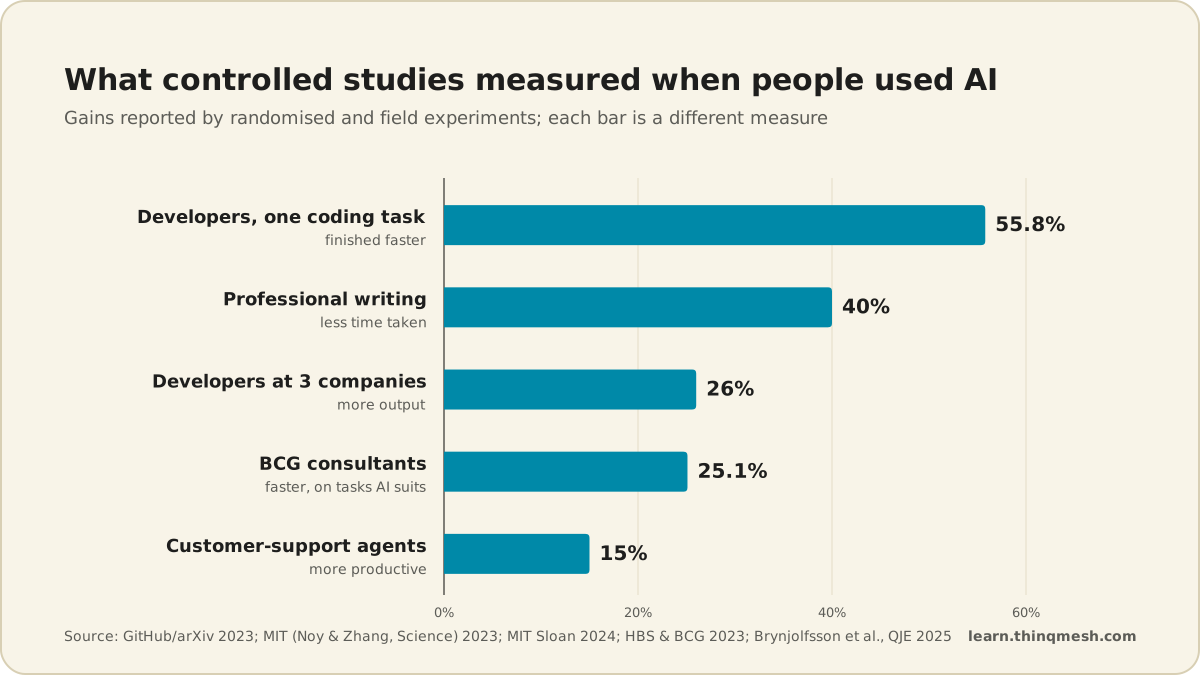
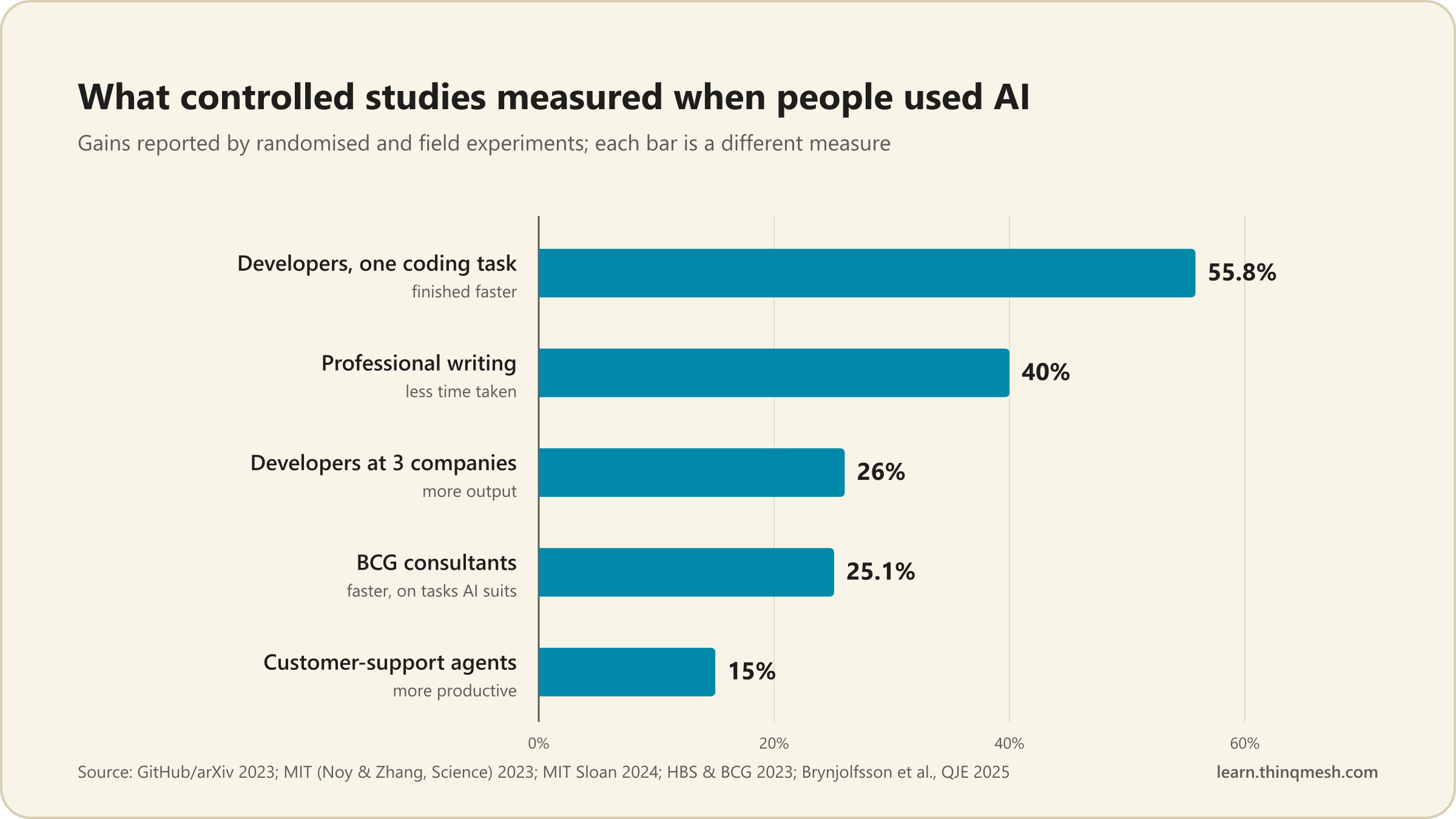
Here is what a shift can look like. These are illustrations, not survey data.
- A new agent at a Gurugram BPM handling a telecom account sees AI-suggested replies and relevant policy snippets as the customer types. He still decides what to say, but no longer hunts through a 200-page manual.
- A senior agent at an insurance process in Pune no longer answers "where is my claim?" because an AI agent handles it. She takes the escalations: disputed claims, upset customers, cases the bot got wrong. BCG estimates AI can resolve up to 70% of simple claims in real time (BCG, 2025).
- A team lead reviews a sample of AI conversations each day, spots where the bot gave wrong answers, and writes corrections to its knowledge base. That is a job that did not exist a few years ago.
AI agent + human team
1.AI takes simple queries
Repetitive questions answered from help content.
2.Hard cases handed over
Angry, complex or unusual ones reach a person.
3.Review AI conversations
Spot where the bot gave wrong answers.
4.Fix the knowledge base
Clear, accurate articles make the bot better.
…then back to step 1
1.AI takes simple queries
Repetitive questions answered from help content.
2.Hard cases handed over
Angry, complex or unusual ones reach a person.
AI agent + human team
4.Fix the knowledge base
Clear, accurate articles make the bot better.
3.Review AI conversations
Spot where the bot gave wrong answers.
The skills to build
Handling what AI hands over. The calls that reach a person will be the angry, complex and unusual ones. Calm problem-solving and clear writing matter more than speed.
Supervising AI. Reading AI conversations, spotting errors, and knowing when the bot should hand over to a human.
Maintaining knowledge. AI agents are only as good as the articles and policies they draw on. People who can write clear, accurate knowledge-base content are valuable.
Reading data. Spotting which queries the AI fails on and why, and suggesting fixes.
Try this week: take five real queries your team handled recently (with customer details removed). Ask an AI assistant to answer each using only your published help articles. Mark which answers are right, which are wrong, and which should have gone to a person. You have just done the core of an AI quality reviewer's job.
What stays human, and the risks
Empathy, judgement and accountability stay human. When a customer is grieving, angry or confused, a person handles it better. Gartner's finding that customers trust human agents more for recommendations is a reminder.
The main risk is wrong answers delivered confidently. KPMG and the University of Melbourne found 66% of employees rely on AI output without evaluating it (KPMG, 2025). In support, that means a customer given the wrong refund policy.
Data is the other. Support teams handle phone numbers, account details and addresses. Keep them out of public AI tools.
What to do next
- Learn your company's AI tools properly, including their limits, not just the buttons.
- Volunteer for escalations or quality review. That is where the new roles are.
- Practise the try-this-week exercise above and share what you find with your team lead.
- Look at GCC roles if you are ready to move, and prepare to show AI skills in the interview.
AI Fluency is taught live in small cohorts, with a project you keep at the end of each month. If you work in support or BPM and want to build these skills, start here.