
6 Sept 2026AI by Role
Revenue up 6.1%, headcount up 2.3%: what India's IT giants now pay for
India's IT revenue grew 6.1% in FY26 while headcount grew 2.3%. Here is what TCS, Infosys and Wipro now pay engineers for, and how to get there.
Author: Team Thinqmesh · 5 min read
- GitHub
- GitHub Copilot
- Cursor
- Claude
- Python
- Docker
- Jira
- Vercel
India's technology industry grew revenue 6.1% to $315bn in FY26, according to NASSCOM, but headcount grew only 2.3% (YourStory, 2026). More work is being done with fewer new hires. For software engineers, the message is clear: the industry is paying for people who can deliver with AI, not just people who can write code.
What the numbers say for engineers
NASSCOM estimates the industry's AI revenue at $10–12bn. Over two million professionals have been upskilled in AI, of whom 200,000–300,000 have advanced AI skills. That is a small share of the workforce, and it is where demand is sharpest.
The big three are all in. Infosys, TCS and Wipro have each deployed Microsoft 365 Copilot to more than 100,000 employees. TCS reports 20–25% productivity gains in research and content tasks. Wipro says it saves more than 250,000 FTE days a quarter and has more than 29,000 agents built by its own employees (Microsoft, 2026).
The roles are changing shape. TCS plans up to 8,900 forward-deployed engineers, who work alongside clients to put AI into use, and spends about $1bn a year on talent development (Reuters, 2026). Infosys hired about 20,000 freshers in FY26, says its annualised AI services revenue has crossed $1bn, and runs about 4,800 AI projects (Storyboard18, 2026).
Clients are changing too. McKinsey found 32% of organisations decided against buying software they could build themselves with coding agents (McKinsey, 2026). That puts pressure on services work that is only about writing code to a specification.
Juniors gain most, and that cuts both ways
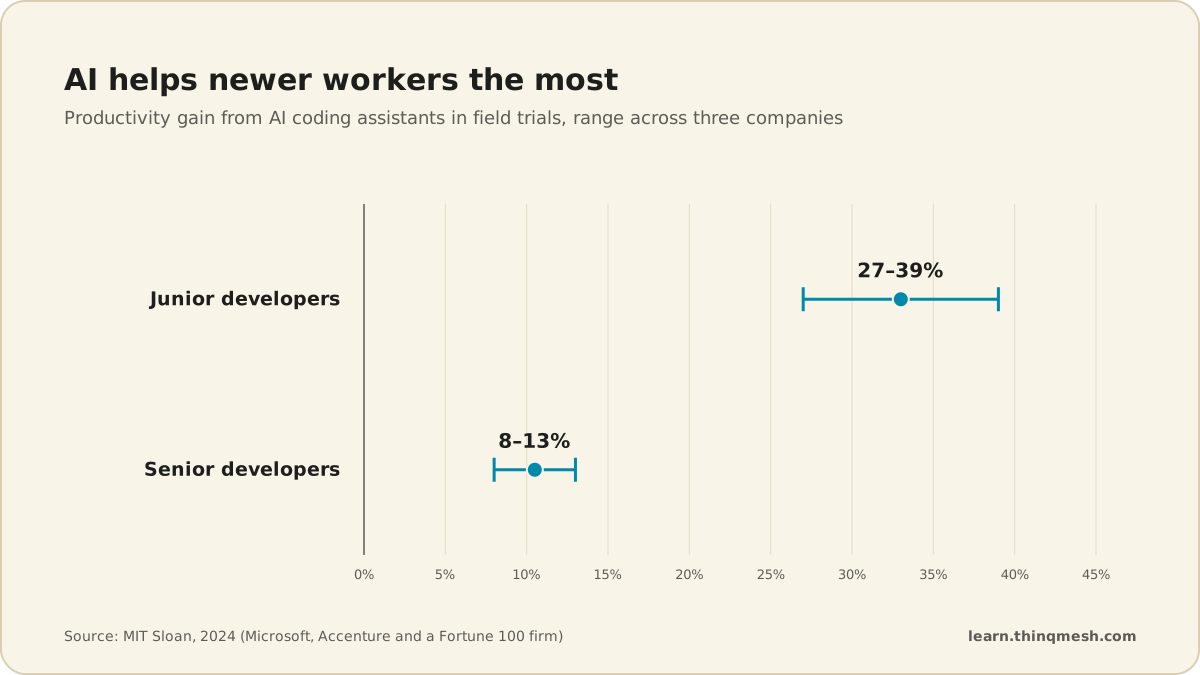
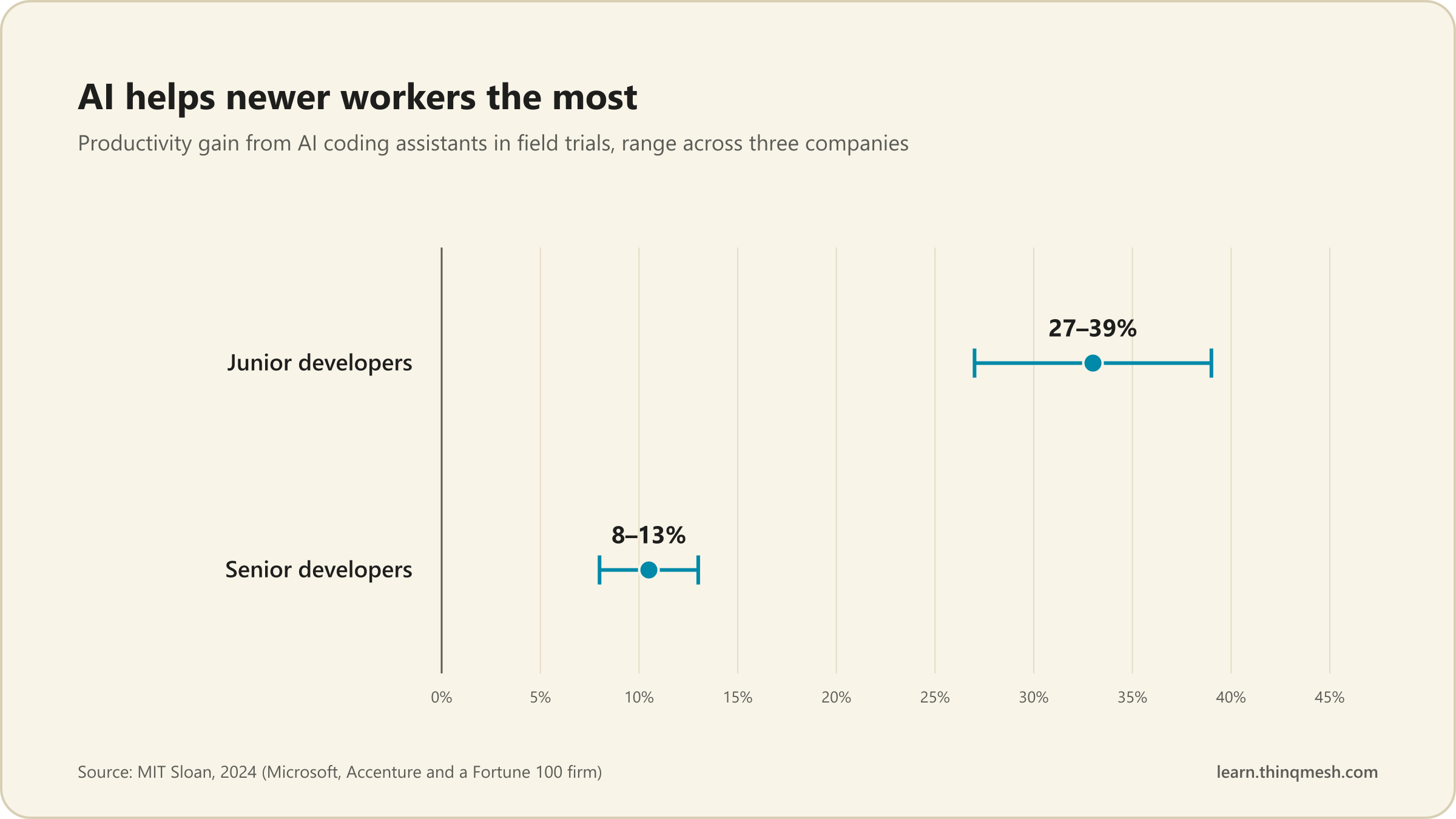
A study of developers at Microsoft, Accenture and a Fortune 100 firm found AI coding assistants raised output by 26%. Juniors gained 27–39%. Seniors gained 8–13% (MIT Sloan, 2024).
That is good news for freshers, with a catch. In a randomised trial, Anthropic found developers who used AI while learning a new coding skill scored 50% on a follow-up quiz, against 67% for those who did not. Those who asked the AI for explanations kept learning (Anthropic, 2026). If you let AI write code you do not understand, you ship faster today and grow slower.
PwC adds another twist: the most AI-exposed junior roles are 7 times more likely to demand skills traditionally expected of seniors (PwC, 2026). The entry bar is rising.
Feeling faster is not being faster
84% of developers use or plan to use AI tools, yet 46% actively distrust their accuracy (Stack Overflow, 2025). That gap is healthy scepticism, and the research backs it up.
In one controlled task, developers finished a web server 55.8% faster with an AI pair programmer (arXiv, 2023). But in METR's 2025 study, 16 experienced open-source developers working on their own projects took 19% longer with AI. They had expected to be 24% faster and still believed they were 20% faster afterwards (METR, 2025). METR's 2026 follow-up now estimates a speed-up, but calls that weak evidence (METR, 2026). The honest reading: AI helps a lot on some tasks, slows you down on others, and your own sense of speed is not a reliable measure.
What the day-to-day work looks like with AI
These are illustrations, not survey data.
- A fresher at a Hyderabad services firm is handed an old Java module with no documentation. She asks AI to explain it function by function, writes tests for the behaviour she now understands, and only then starts changing it.
- A mid-level engineer in Bengaluru uses a coding agent to move a library to its new version across forty files. He reviews every diff, runs the tests, and rejects three changes the agent got subtly wrong.
- A tech lead builds a small internal agent that reads support tickets and drafts a first-pass bug report with logs attached. The team decides which ones to fix.
You + a coding assistant
1.Ask it to explain
Understand the code before you change it.
2.Write tests first
Pin down the behaviour you now understand.
3.Let AI make the change
Small, reviewable diffs.
4.Review every diff
Edge cases, security, and does it solve the problem?
…then back to step 1
1.Ask it to explain
Understand the code before you change it.
2.Write tests first
Pin down the behaviour you now understand.
You + a coding assistant
4.Review every diff
Edge cases, security, and does it solve the problem?
3.Let AI make the change
Small, reviewable diffs.
The skills to build
Reviewing AI code. Reading a diff critically is now as important as writing one. Check edge cases, security and whether it actually solves the problem.
Testing first. Tests are how you know AI-written code works. Engineers who write good tests can use AI safely.
Building with AI, not just using it. Retrieval, tool use, agents and evaluations are what forward-deployed and AI-services roles need.
Understanding the client's problem. As code gets cheaper, knowing what to build becomes the scarce skill.
Try this week: pick a bug you fixed recently. Ask an AI assistant to fix it from scratch, without your fix. Compare the two. Then ask it to explain its reasoning line by line, and note one thing it missed and one thing you learned.
What stays human, and the risks
Design decisions, security judgement, and owning what ships stay human. The risks are skills that never form, code nobody on the team understands, and confident output nobody checked. Keep client code and credentials out of any tool your company has not approved.
What to do next
- Measure, don't guess. Time a few real tasks with and without AI for two weeks.
- Use AI to learn, not only to finish. Ask it to explain before you accept.
- Build one small agent that solves a real problem at work, with tests and an evaluation.
- Learn the client side. Sit in on one requirements call this month.
AI Fluency is taught live in small cohorts. Month two covers retrieval, tools and connecting agents to real systems, and each month ends with a project you keep. See the programme.